


TDA

1,51,905+ Happy Faces & Glowing Smiles | 4.8★ Google Rating | 1,900+ Trusted Reviews

Dermal Fillers

Dermal Fillers Treatment in Pune Procedure, Benefits & Cost Explained

Dermal Fillers Treatment in Pune: Procedure, Benefits & Cost Explained

Introduction Have you looked in the mirror lately and noticed a few extra lines? Or maybe you feel like your cheeks have lost their youthful plumpness. Do not worry; it happens to all of us. Aging is a completely natural process, but looking tired does not have to be your permanent reality. When creams and serums stop delivering the results you want, it is time to look at advanced, non-surgical solutions.  If you are searching for a safe, quick, and highly effective way to refresh your face, you are in exactly the right place. Welcome to your ultimate guide on Dermal Fillers Treatment in Pune. At The Daily Aesthetics, our core mission is simple: helping you feel confident & beautiful, always.  Whether you want to plump your lips, smooth out deep smile lines, or restore lost volume under your eyes, dermal fillers offer a magical, minimally invasive solution. Let’s break down everything you need to know about fillers, from the step-by-step procedure and amazing benefits to the real costs involved here in Pune.  Key Takeaways What Are Dermal Fillers? Dermal fillers are non-surgical, gel-like injectables placed beneath the skin to restore lost volume, smooth out deep creases, and beautifully enhance facial contours. Think of your skin like a plush, firm mattress. When you are young, this mattress is packed with collagen, elastin, and hyaluronic acid. These elements keep your skin bouncy and firm. As we age, our bodies produce less of these essential proteins. The “mattress” begins to thin out, leading to sagging skin, hollow cheeks, and noticeable wrinkles.  Dermal fillers step in to replace that lost support. They are carefully injected beneath the skin’s surface to literally “fill in” the gaps. Unlike our Anti-Wrinkle Treatment (Botox), which temporarily relaxes the facial muscles that cause dynamic wrinkles, fillers add physical volume to the face. They plump, lift, and sculpt.  At The Daily Aesthetics, we’ve seen patients completely transform their confidence in just one 30-minute session. It is not about changing how you look; it is about restoring how you used to look.  How Do Dermal Fillers Work? Dermal fillers work by physically plumping the skin from the inside out, binding with water to create natural volume, and in some cases, stimulating your body’s own collagen production.  When an expert dermatologist injects a filler into a targeted area, the gel instantly provides support to the overlying skin. Here is a simple analogy: imagine a deflated balloon. When you add air (or in this case, filler), the surface of the balloon becomes smooth, tight, and lifted again.  Most modern fillers are made of Hyaluronic Acid (HA). HA is a sugar molecule that naturally exists in your body, particularly in your skin and joints. Its primary job is to hold moisture. In fact, HA can hold up to 1,000 times its weight in water! When injected, the HA filler acts like a tiny sponge beneath your skin. It draws in water, keeping the area plump, hydrated, and completely natural-looking. Over time, your body naturally and safely absorbs the filler.  Ready to Restore Your Youthful Glow? Say goodbye to invasive procedures. Book your non-surgical consultation with our experts at The Daily Aesthetics today and rejuvenate your skin safely. Book Your Consultation Now Types of USFDA-Approved Dermal Fillers We Use  We offer a comprehensive range of USFDA-approved face fillers, including Hyaluronic Acid, Calcium Hydroxylapatite, Poly-L-Lactic Acid, and PMMA, tailored to your specific skin needs. Not all fillers are created equal. Different areas of the face require different types of support. A filler used for delicate under-eye hollows will be much thinner and softer than a filler used to sculpt a strong jawline. Here are the premium types of fillers we use:  1. Hyaluronic Acid (HA) Fillers  This is the most popular and versatile type of filler globally. Because HA is naturally found in your body, the risk of an allergic reaction is incredibly low.  2. Calcium Hydroxylapatite (CaHA) Fillers  CaHA is a thicker, more substantial filler. It contains microscopic calcium particles suspended in a smooth gel. These particles are similar to the minerals found naturally in your bones.  3. Poly-L-Lactic Acid (PLLA) Fillers  Unlike HA fillers that provide instant volume, PLLA is known as an “advanced collagen stimulator”. It works gradually by helping your body rebuild its own natural collagen over time.  4. Polymethylmethacrylate (PMMA) Fillers  PMMA is a semi-permanent filler. It contains tiny collagen microspheres that remain beneath the skin to provide long-term structural support.    Popular Treatment Areas for Dermal Fillers  Dermal fillers are incredibly versatile and can be used to treat the cheeks, lips, under-eyes, smile lines, forehead, nose, and jawline.  Where can we use these magic gels? Almost anywhere your face needs a little extra love. Here is a breakdown of the most popular treatment areas:  Plumping and Defining Lips Whether you have naturally thin lips or have lost volume due to age, lip fillers are a highly requested treatment. We use soft HA fillers to add natural plumpness, define the lip borders, and smooth out vertical “smoker’s lines” above the mouth.  Restoring Hollow Cheeks As you age, the fat pads in your cheeks slowly slide downward. This causes the mid-face to look flat or sunken. Injecting a firmer filler (like CaHA) into the cheeks acts like a scaffolding. It lifts the entire mid-face, giving you a youthful, contoured look.  Brightening Under-Eye Hollows (Tear Troughs) Do people constantly tell you that you look tired, even when you have slept for 8 hours? Hollows under the eyes cast shadows that look like dark circles. We use very fine, soft HA fillers to gently fill this delicate area, instantly making you look refreshed and awake.  Smoothing Smile Lines (Nasolabial Folds) These are the deep brackets that run from the sides of your nose down to the corners of your mouth. Thicker fillers are excellent at pushing these creases up and smoothing the transition between your cheeks and mouth.  Sculpting the Jawline and Chin You do not need invasive surgery to get a sharp, defined jawline. We use firm, structural fillers to build out a weak chin, reduce the appearance of jowls, and create a crisp, celebrity-like jawline contour.  Non-Surgical

Dermal Fillers Treatment in Pune: Procedure, Benefits & Cost Explained Read More »

Dermal Fillers
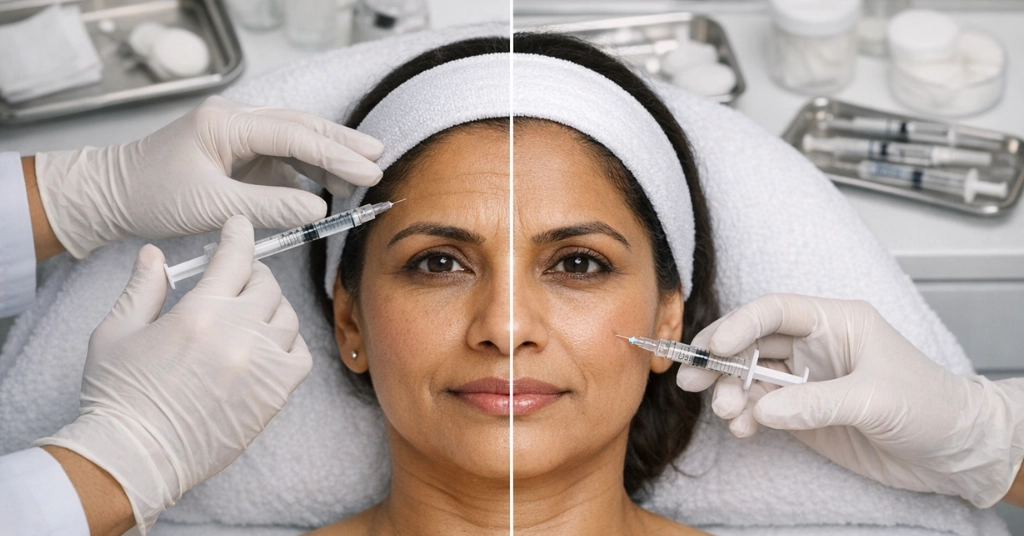
Dermal Fillers vs Botox Which Treatment is Right for You

Dermal Fillers vs Botox: Which Treatment is Right for You?

Introduction You look in the mirror and notice something has changed.   The lines on your forehead seem deeper. Your smile lines linger longer. Maybe your cheeks do not look as full as they used to.   You have heard about Botox and dermal fillers, but now you are stuck wondering which one is actually right for you.  If you feel confused, you are not alone. Many people use the terms Botox and fillers interchangeably. In reality, they are completely different treatments that solve different problems.   Choosing the right one depends on what is causing your concern in the first place.  Are your wrinkles caused by repeated facial movement? Or are they caused by volume loss and collagen breakdown?  That is the key question.  Both Botox and dermal fillers are non-surgical cosmetic treatments. They are quick, minimally invasive, and widely used.   According to the American Society of Plastic Surgeons, millions of injectable treatments are performed every year in the United States.  But popularity does not automatically mean one is better than the other. The right treatment for you depends on your facial anatomy, your age, your goals, and your expectations.  In this guide, you will learn exactly how Botox works and how dermal fillers work. You will understand the real difference between muscle-related wrinkles and volume-related aging. You will discover which treatment is better for forehead lines, smile lines, lip enhancement, cheek volume, and preventative anti-aging. What is Botox?  If you are thinking about smoothing wrinkles without surgery, Botox is usually the first treatment you hear about.   It has been used cosmetically for decades and remains one of the most requested non-surgical procedures in the United States.  Botox is a brand name for botulinum toxin type A. It is an FDA-approved neuromodulator that temporarily relaxes specific facial muscles.  The word toxin can sound intimidating. However, in cosmetic treatments, it is used in very small, controlled amounts. When injected by a licensed and experienced provider, it is considered safe and effective.  Botox is not a filler. It does not add volume to your face. Instead, it works on the muscles beneath your skin.  Every time you smile, frown, squint, or raise your eyebrows, your facial muscles contract. Over time, these repeated movements create lines in the skin. These are called dynamic wrinkles because they form from movement.  Botox works by blocking the nerve signals that tell certain muscles to contract. When those muscles relax, the skin above them appears smoother.  How Botox Works  The treatment itself is quick. Most appointments take about 10 to 20 minutes. A very fine needle is used to inject small amounts of Botox into targeted muscles.  You will not see results immediately. Most people begin to notice smoother skin within three to seven days. Full results usually appear around two weeks after treatment.  The effects are temporary. On average, Botox lasts about three to four months. After that, muscle movement gradually returns, and lines may start to reappear.  Many people schedule maintenance appointments three or four times per year to keep results consistent.  Best Treatment Areas  Botox works best for areas where wrinkles are caused by muscle movement. These include:  If your wrinkles are most noticeable when you make facial expressions, Botox is often the right solution.  What Botox Does Not Do  It is important to understand Botox’s limitations.  Botox does not:  If your concern is volume loss rather than muscle movement, you will likely need dermal fillers instead. What Are Dermal Fillers?  If Botox relaxes muscles, dermal fillers restore volume.  As you age, your face naturally loses collagen, fat, and bone density.   This process starts earlier than most people realize, often in your late 20s. Over time, that volume loss can make your cheeks look flatter, your under eyes appear hollow, and your smile lines more pronounced.  Dermal fillers are gel-like substances injected beneath the skin to restore lost volume.   The most common type of filler is made from hyaluronic acid, a substance your body naturally produces to keep skin hydrated and plump.  Unlike Botox, fillers do not affect muscle movement. Instead, they physically fill in areas that have thinned or hollowed over time.  Hyaluronic acid fillers are popular because they:  Attract water  Add immediate volume  Provide soft and natural results  Can be dissolved if needed  Other types of fillers stimulate collagen production over time, helping your skin gradually regain structure.  How Fillers Work  Think of dermal fillers as support beneath your skin.  When volume decreases in your face, the skin has less structural support. That can create folds, sagging, and shadows. By placing filler strategically, your provider restores contour and balance.  Results are visible immediately after treatment, although mild swelling can temporarily exaggerate the effect for a few days.  Depending on the product used and the treatment area, fillers typically last between 6 and 24 months.  Common Treatment Areas  Dermal fillers are commonly used for:  If your concern is sagging, hollowing, or loss of facial fullness, fillers are usually the better choice.  What Fillers Do Not Do  Dermal fillers do not stop muscle movement. They will not prevent dynamic wrinkles from forming if those wrinkles are caused by repeated expressions.  If you have deep forehead lines that appear when you raise your eyebrows, filler alone will not solve the problem. That is where Botox may come in.  Now that you understand how both treatments work individually, it is time to compare them side by side. Botox vs Dermal Fillers: Key Differences  Now that you understand how Botox and dermal fillers work on their own, let’s compare them directly.  This is where most confusion disappears.  Botox and fillers both reduce signs of aging. But they work in completely different ways. One relaxes muscles. The other restores volume. If you mix that up, you may choose the wrong treatment for your concern.  Let’s break it down clearly.  Feature  Botox  Dermal Fillers  Purpose  Relaxes muscles  Restores volume  Best For  Dynamic wrinkles  Static wrinkles and hollow areas  Results  3 to 7 days  Immediate  Duration  3 to 4 months  6 to 24 months  Prevents wrinkles  Yes  No  Adds volume  No  Yes  Which Treatment is Right for You?  Now that you understand the difference between Botox and dermal fillers, let’s make this personal.  You do not need both treatments just because

Dermal Fillers vs Botox: Which Treatment is Right for You? Read More »

Botox Treatment, Dermal Fillers
Call
Scroll to Top