

Introduction
A fine line you never noticed before, makeup settling into a new crease, or skin that no longer feels quite as smooth can make you wonder what is changing. You may not want a different-looking face. You may simply want your skin to feel a little more like itself again.
Microneedling for anti-aging uses tiny, controlled punctures to start a natural repair response. Over time, that response may support collagen remodelling, improve uneven texture and soften the appearance of some fine lines. It is a skin-quality treatment, not an instant lift, a replacement for lost facial volume or a way to stop ageing altogether.
At The Daily Aesthetics Clinic, patients in Pune can explore professional Dermapen microneedling after an assessment of their skin type, goals and pigmentation risk. The useful question is not whether microneedling is fashionable. It is whether the particular changes you notice are the kinds of changes this treatment can reasonably address.
This guide explains the biology in everyday language, separates realistic results from exaggerated promises and helps you recognise when a different anti-ageing treatment may make more sense.
Key Takeaways
- Collagen remodelling takes time: Microneedling triggers a healing response rather than producing an instant, fixed amount of new collagen.
- Fine lines and texture are stronger targets: Selected superficial wrinkles, roughness and uneven-looking pores may improve gradually.
- Firmer-looking does not mean lifted: Mild changes in skin quality are possible; heavy sagging and lost volume need different strategies.
- Most clinical studies use multiple sessions: The right number and spacing depend on the skin concern and the clinician’s assessment.
- Standard and RF microneedling are different: RF adds heat energy and brings distinct benefits and risks.
- Indian skin needs pigment-aware planning: Post-inflammatory darkening can still occur, making technique, sun protection and aftercare important.
- Treatment suitability is individual: Active infection, certain skin conditions, healing problems and medication history can change the plan.
What Happens to Skin as It Ages?
Skin ageing involves more than one change. Collagen fibres gradually become less organised, elastin support can weaken, surface renewal may slow and years of sun exposure can leave skin looking rougher or uneven. Natural facial movement also creates lines. The result may be less bounce, finer creases and a texture that looks different under bright light.
Not every wrinkle has the same cause. A fine line visible when your face is relaxed is different from a crease that appears mainly when you smile. Likewise, a hollow beneath the eyes is often a volume or anatomy issue, while a rough cheek may be more about surface and dermal skin quality.
- Fine lines: Often become more noticeable as skin support and hydration change.
- Uneven texture: May reflect photoageing, surface roughness or old blemish-related changes.
- Visible pores: Can appear more prominent with oiliness, texture changes and reduced surrounding support.
- Less resilience: Skin may feel thinner or less springy without having truly descended or sagged.
- Sagging or hollows: Usually involve deeper tissue and structural changes beyond the reach of standard microneedling alone.
This is why a useful anti-ageing consultation begins by identifying what has changed, rather than recommending the same procedure for every concern.
Not Sure Whether Your Skin Needs Collagen Support or Hydration?
Fine lines, dryness, texture and looseness can look similar in the mirror but often call for different approaches. Start with a professional skin assessment.
Book a Skin ConsultationHow Does Microneedling Support Collagen Remodelling?
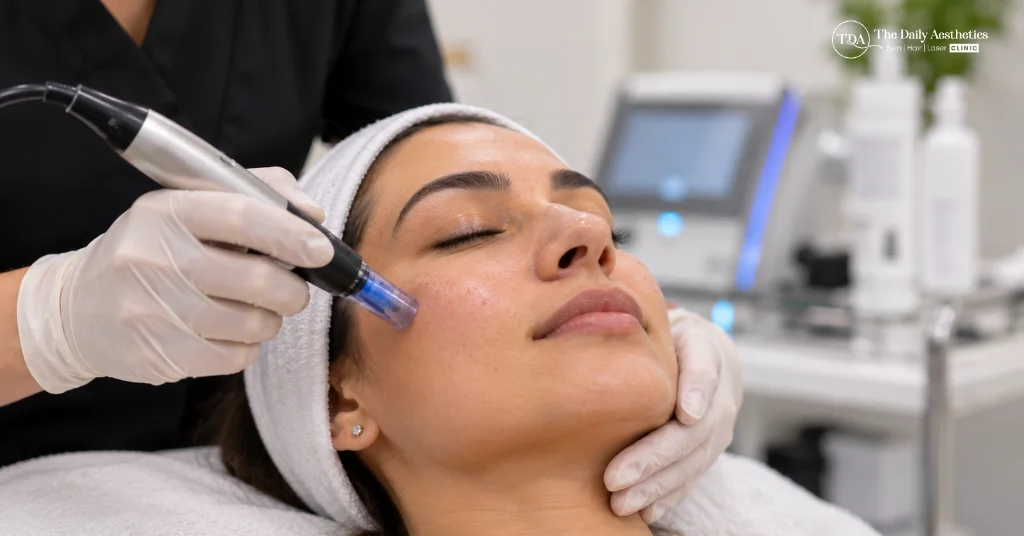
Professional microneedling makes carefully controlled micro-injuries in the skin using a pen-shaped device with fine needles. The punctures set off a wound-healing response. Cells release signals, repair processes become active and fibroblasts—the cells involved in producing the skin’s supportive matrix—participate in remodelling collagen and other structural components.
Think of it as prompting a repair project, not adding collagen from a bottle. The body must carry out each stage. The first visible redness is part of a short-term reaction; the gradual changes people hope to see come later as skin repairs and reorganises its structure.
- Controlled stimulation: The treatment creates small, planned channels rather than broad surface damage.
- Early response: Temporary redness and inflammatory signalling are part of tissue repair.
- Fibroblast activity: Skin cells involved in making and organising collagen respond during healing.
- Matrix remodelling: Collagen and other supportive material may reorganise over the following weeks and months.
- Visible change: Suitable patients may notice a smoother surface or softer fine lines, although improvement is not guaranteed.
Needle depth, number of passes, treatment area and skin condition influence the response. More aggressive needling is not automatically better. Excess injury can raise the risk of inflammation, scarring or pigmentation, especially when skin is already irritated.
The biology behind collagen-induction treatment is encouraging, but a healing mechanism is not the same as proof that every patient will achieve a specific degree of firmness or wrinkle reduction. Good results depend on selecting the right concern and a safe protocol.
Explore Professional Dermapen Microneedling
Adjustable treatment depth allows the approach to be matched to the area, skin condition and rejuvenation goal, rather than treating every face in exactly the same way.
Explore Microneedling TreatmentWhat Does the Evidence Say About Microneedling for Facial Rejuvenation?
Clinical research suggests that professional microneedling can be useful for selected signs of facial ageing, particularly wrinkles and texture. Still, studies vary in devices, needle depths, number of sessions, combination therapies and how improvements are measured. This makes it difficult to give one reliable percentage or universal treatment timeline.
A 2025 systematic review of 21 studies involving 723 patients evaluated microneedling for facial rejuvenation. Wrinkling was the most frequently studied outcome, followed by texture, photoageing and skin laxity. Patient satisfaction was generally favourable, but the review identified a lack of standardised outcome measures and called for stronger research.
A positive study does not mean every skin concern improves equally. It also does not tell you that a particular machine, add-on product or individual treatment schedule will reproduce the same result. The most useful reading of the evidence is promising but measured: texture and fine-line changes are plausible, while a dramatic lift is not an established expectation for mechanical microneedling.
| Evidence Area | What Research Supports | What It Does Not Prove |
| Facial rejuvenation studies | Possible improvement in wrinkles and skin texture with repeat treatment in selected patients. | That one session or every device produces the same result. |
| Collagen-remodelling biology | Micro-injury initiates a healing response involving fibroblasts and extracellular matrix. | A fixed collagen increase or permanent prevention of skin ageing. |
| Skin laxity outcomes | Mild visible firmness changes may be reported in some treatment settings. | Correction of jowls, major sagging or lost facial volume. |
| Safety research | Temporary redness and other short-lived effects are common and usually manageable. | That complications cannot occur or that home needling is equivalent to trained treatment. |
Bottom Line: Microneedling has credible potential for selected skin-quality concerns. Its strongest value is gradual improvement in texture and fine lines, not guaranteed tightening or age reversal.
Which Signs of Ageing May Microneedling Improve?
The best candidates often describe a skin-quality problem rather than a change in facial shape: makeup catches on fine lines, cheeks feel rough, or pores appear more obvious in certain lighting. These concerns are different from heavy jowls or pronounced hollows, even if both are loosely described as ageing.
Fine Lines and Wrinkles
Fine lines that are visible at rest may soften as skin texture and dermal support improve. Deep expression lines caused mainly by repeated muscle movement often need another approach; microneedling does not relax facial muscles. Results tend to be subtle and build rather than appearing immediately after treatment.
Uneven Texture and Visible Pores
For many people, smoother texture is a more realistic goal than looking younger by a fixed number of years. Microneedling may improve roughness and the appearance of enlarged pores, but it does not permanently close pores or remove them. Skin care, active acne and oil production can still influence how the surface looks.
Mild Loss of Firmness
A modest increase in the appearance of bounce or resilience may follow dermal remodelling in suitable skin. This is different from repositioning deeper tissues. Someone with early crepiness may be pleased with a subtle change, while someone hoping to lift the lower face substantially may be disappointed if expectations are not discussed upfront.
| Main Concern | Microneedling May Help With | Important Limit |
| Fine static lines | Gradual softening of some superficial lines. | It does not stop facial muscle movement. |
| Rough or uneven texture | A smoother-looking surface over time. | It is not an instant resurfacing result. |
| Visible pores | Making some pores less conspicuous. | It cannot permanently eliminate pores. |
| Mild crepey appearance | Selected improvements in skin quality. | Not a solution for major sagging. |
| Deep folds or volume loss | Limited direct benefit for the underlying structure. | May need a different treatment mechanism. |
Bottom Line: Match the treatment to the visible cause. Collagen support can help some skin-quality concerns; it cannot replace lost volume or lift heavy tissue.
Fine Lines, Texture and Laxity Need Different Strategies
A tailored plan looks at what is changing in your skin, not simply whether a treatment is described as “anti-ageing.”
Get Expert Skin AdviceCan Microneedling Tighten Sagging Skin?
Standard microneedling may make mildly crepey skin look firmer through gradual changes in the dermal matrix. It cannot reliably lift significant jowls, remove excess skin or reposition deeper facial structures. Those goals require an assessment of tissue laxity, facial volume and whether a different technique is appropriate.
The distinction is easy to miss in before-and-after photos. Better lighting, hydration and surface smoothness can make the face look refreshed even when the deeper shape has not changed. Ask what the treatment is actually expected to improve: the skin surface, its firmness, or the position of the underlying tissue.
When deeper laxity is the main concern, a discussion of HIFU skin-tightening treatment or other clinician-selected options may be more relevant than expecting microneedling to act like a facelift.
How Long Does Collagen Remodelling Take After Microneedling?
The redness seen soon after microneedling is not the final anti-ageing result. Surface recovery usually takes days, while collagen remodelling is a slower biological process that may continue over the following weeks and months. Many facial rejuvenation studies use more than one session, but schedules differ and cannot be translated into a universal prescription.
- Immediately after treatment: Skin may feel warm, tight or sensitive and can look red or darker than usual depending on skin tone.
- First few days: Temporary dryness, mild swelling or flaking may occur while the barrier recovers.
- Following weeks: A smoother feel or gradual textural change may become more noticeable in some people.
- After a treatment course: Your clinician can compare photographs, texture and fine-line appearance under consistent conditions.
It helps to judge progress using the same lighting and angles instead of daily selfies or filtered photographs. Some people notice changes in skin feel before they notice a visible difference. Others need a different treatment because their main concern was deeper laxity or pigmentation rather than texture.
The interval between sessions should allow adequate healing. A clinician may also adjust the plan if irritation persists, especially for someone prone to post-inflammatory pigmentation. More frequent treatment is not automatically a faster route to better collagen.
Standard Microneedling vs RF Microneedling: Are They the Same?
No. Standard microneedling uses mechanical needle punctures to stimulate a wound-healing response. Radiofrequency (RF) microneedling also delivers electrical energy as heat into the skin through the needles. Because the mechanisms are different, the safety questions, device settings and potential outcomes should not be treated as interchangeable.
Dermapen 4 is a precision mechanical microneedling device used at The Daily Aesthetics Clinic. Its adjustable needle depth supports individualised planning, but the presence of a Dermapen does not mean that an RF procedure is being performed.
| Feature | Standard Dermapen Microneedling | RF Microneedling |
| Primary action | Controlled mechanical micro-injury. | Needles plus controlled radiofrequency heating. |
| Common goal | Surface/dermal texture and fine-line support. | Selected texture and tightening goals, device-dependent. |
| Planning factors | Needle depth, passes, skin condition, healing. | Depth, thermal settings, skin anatomy and provider experience. |
| Safety consideration | Pigment change, infection and scarring remain possible. | Separate thermal risks, including rare serious complications. |
The official RF microneedling safety communication reports serious complications with certain RF procedures, including burns, scarring, fat loss and nerve damage. Those reports concern RF devices and should not be casually attributed to standard mechanical microneedling, although both require trained care and informed consent.
Microneedling vs Other Anti-Aging Treatments: Which Goal Fits Best?
There is no single best anti-ageing treatment because the word “ageing” can refer to a rough surface, dehydration, wrinkles caused by muscle movement, facial volume loss or deeper sagging. Each concern involves a different layer or mechanism. Sometimes one treatment is enough; sometimes the safer choice is to stage different treatments after assessment.
| Treatment Approach | Usually Considered For | What to Keep in Mind |
| Mechanical microneedling | Fine lines, uneven texture and collagen-remodelling support. | Gradual improvement; not deep lifting. |
| Skin boosters | Hydration, radiance and selected skin-quality concerns. | Formulation matters; not a substitute for structural volume. |
| HIFU or other tightening options | Selected deeper laxity and tissue-tightening goals. | Suitability depends on anatomy and degree of sagging. |
| Fillers or other volume strategies | Hollows or folds driven by structural volume loss. | Different risks and anatomical considerations; not resurfacing. |
Bottom Line: Start with your concern, then compare treatment mechanisms. A gentle hydration treatment cannot replace a lift, and microneedling cannot fix every wrinkle or hollow.
Is Microneedling Suitable for Indian Skin Tones?
Microneedling may be considered for a range of Indian skin tones, including people who are cautious about heat-based procedures. Because standard microneedling does not use a laser or radiofrequency heat, its mechanism differs from those devices. That does not make it risk-free: irritation and post-inflammatory hyperpigmentation can still happen.
If your skin darkens after a pimple, insect bite or small scratch, tell your practitioner. This history matters when choosing treatment intensity and planning aftercare. Active tanning, strong sun exposure, melasma, recent peeling or a damaged skin barrier may change whether treatment should go ahead.
- Sun protection matters: Consistent photoprotection before and after treatment reduces avoidable irritation and pigment risk.
- Depth should be individualised: More needles or greater depth are not a shortcut to better results.
- Skin condition should be checked: Inflammation, active breakouts and irritant reactions may need care before any procedure.
- Aftercare should be simple: Follow the treating clinician’s instructions rather than adding exfoliating acids or retinoids immediately.
People in Pune often balance office commutes, outdoor travel and regular sun exposure. Scheduling the procedure when you can protect healing skin and attend a follow-up may be more useful than choosing the nearest available appointment before an event.
Who Should Avoid or Postpone Microneedling?
Microneedling should be discussed with a trained clinician rather than treated as a safe-at-home beauty hack. Conditions that alter healing or increase inflammation can make treatment inappropriate or change the timing. Suitability cannot be confirmed by a short online checklist.
- Active skin infection or cold sores: Infection risk and the chance of flare-up need assessment first.
- Inflamed acne, eczema, rosacea or significant irritation: The underlying problem may need control before needling.
- Keloid or poor wound-healing history: A practitioner must evaluate scarring risk.
- Certain medicines or medical conditions: Blood-thinning drugs, immune suppression and other factors can alter planning.
- Recent sunburn, strong tanning or an upcoming period of heavy sun exposure: It may be better to postpone.
- Pregnancy or breastfeeding: Discuss the procedure and available evidence with a qualified clinician before proceeding.
A helpful starting point is to review the microneedling safety guidance and then discuss your own medical and skin history in consultation. A trained provider should explain risks, hygiene, single-use cartridges and appropriate follow-up.
What About Microneedling With PRP, PDRN, Growth Factors or Exosomes?
Microneedling is sometimes paired with platelet-rich plasma or selected skin-quality preparations. The biological idea is appealing, but the evidence and risks vary by ingredient, formulation and route of delivery. A product that is safe on unbroken skin is not automatically suitable for use over fresh micro-channels.
Sterility, ingredients, intended use and local regulatory requirements matter. Results reported for one combination should not be taken as proof that every serum, DNA-derived product or exosome preparation improves outcomes. Nor should a combination be recommended solely because a new ingredient is trending online.
If an add-on is proposed, ask what specific problem it is intended to address, whether it is appropriate for use with microneedling, what evidence supports the protocol and what extra risks it introduces. It is reasonable to decline an add-on or request a simpler plan.
Considering Microneedling in Pune?
Your skin type, history of pigmentation, degree of fine lines and treatment goals should guide the plan and aftercare.
Book Your ConsultationWhere Can You Get Microneedling for Anti-Aging in Pune?
For someone considering microneedling for anti-aging in Pune, follow-up access is often as important as the first appointment. A thoughtful plan includes a skin assessment, discussion of expected changes, aftercare instructions and a way to review progress rather than assuming the first session answers every question.
The Daily Aesthetics Clinic has locations in Kalyani Nagar, Kharadi and Baner. You can choose the branch that is most convenient for consultation and follow-up; availability of individual procedures or practitioners should be confirmed when booking.
| Clinic | Address | Phone |
| Kalyani Nagar | Plot 17, Lane No. 7, next to Hotel Sudharshan, opposite Lunkad Sky Lounge, Kalyani Nagar, Pune, Maharashtra 411006 | +91 96738 58066 |
| Kharadi | Shop No. 120, Gera Imperial, Rajaram Patil Nagar, Vittal Nagar, Kharadi, Pune, Maharashtra 411014 | +91 97685 55421 |
| Baner | Shop No. 11, A-wing, SR. No. 32, Sterling Tower, Off Pancard Club Road, Baner, Pune, Maharashtra 411045 | +91 91585 80123 |
Why Choose The Daily Aesthetics Clinic?
Good anti-ageing care starts by listening. You may want less texture, a fresher-looking surface or a softer fine line without changing the expression that makes your face your own. A consultation should recognise those goals, explain what is achievable and leave room to decide without pressure.
The Daily Aesthetics Clinic offers Dermapen 4 microneedling with adjustable depth, alongside broader anti-ageing and skin-quality treatment options. The aim is to choose a method based on your skin, not to fit everyone into the same procedure. A qualified team can also advise when microneedling is not the best match for deeper laxity or volume-related changes.
Before treatment, ask about the planned device, your skin’s pigment response, expected recovery, the need for repeat visits and how progress will be assessed. Clear answers are more valuable than promises of “instant collagen” or an effortless facelift.
Build an Anti-Aging Plan Around Your Skin
Microneedling, skin boosters and tightening treatments address different concerns. Compare your options with the clinic team before choosing.
Contact The Daily Aesthetics ClinicConclusion
Microneedling for anti-aging can support the skin’s repair processes and may gradually improve the appearance of selected fine lines, rough texture and mild loss of firmness. Its effect is about skin quality and collagen remodelling, not replacing lost volume or lifting significantly sagging skin.
The best next step is to understand which layer of skin ageing is bothering you and whether a professional procedure is appropriate for your skin tone, health and expectations. Improvements take time, and a safe plan should include realistic outcomes, aftercare and follow-up.
If you would like a personalised opinion on collagen-supporting treatment in Pune, contact The Daily Aesthetics Clinic to discuss your concerns and whether microneedling or another approach could be more suitable.
Frequently Asked Questions
1. Does Microneedling Really Stimulate Collagen?
Microneedling creates controlled micro-injuries that trigger a healing response involving fibroblasts and collagen remodelling. Human studies support its potential for selected texture and wrinkle concerns, but no fixed collagen increase or individual result can be promised.
2. Is Microneedling Good for Anti-Aging?
It may be useful for people whose main concerns are fine lines, uneven texture or mild changes in skin quality. It is less suited to correcting major sagging, deep folds from volume loss or expression lines driven primarily by muscle activity.
3. Can Microneedling Reduce Fine Lines and Wrinkles?
Some superficial lines may soften gradually as skin quality changes. Deep wrinkles and dynamic expression lines may respond better to other treatments. Results vary with the individual, device settings, skin condition and treatment plan.
4. Can Microneedling Make Skin Look Firmer?
Some patients may see a subtle improvement in the appearance of firmness as the skin remodels. Standard microneedling does not lift heavy jowls or replace a facelift, and significant laxity needs a different assessment.
5. How Many Microneedling Sessions Are Usually Needed for Skin Rejuvenation?
Many facial rejuvenation studies use multiple visits, but the number and spacing vary. A clinician should recommend a schedule based on the concern, healing response, skin tone, risks and progress rather than a universal package.
6. How Long Does It Take to See Microneedling Results?
Redness and tightness may occur immediately, but these are not the final results. Texture changes may become more noticeable over subsequent weeks, while collagen remodelling can continue longer. Some people need more than one session.
7. Is Microneedling Safe for Indian Skin Tones?
It may be suitable for many Indian skin tones when performed and followed up appropriately. However, irritation, hyperpigmentation, infection and scarring remain possible. A history of dark marks after inflammation should be discussed before treatment.
8. What Is the Difference Between Standard Microneedling and RF Microneedling?
Standard microneedling creates mechanical micro-injuries. RF microneedling also delivers heat through needle electrodes and has a distinct risk and evidence profile. The two techniques should not be treated as interchangeable.