

Introduction
A tattoo can carry a story. Sometimes that story still feels right, and sometimes it no longer matches who you are, where you work, how you dress, or what you want to see in the mirror every day.
For some people, tattoo removal is practical. A visible tattoo may affect job applications, uniforms, family events, or professional confidence. For others, it is deeply personal. It may be connected to an old phase, an old relationship, a spelling mistake, a faded design, or a memory they are ready to move away from.
Laser tattoo removal is not a one-session eraser. At The Daily Aesthetics Clinic in Pune, the right question is not only “Can this tattoo be removed?” It is “How many sessions might my tattoo need, and what can affect the result?”
Most tattoos fade gradually because the laser breaks ink into tiny particles and the body clears those particles over time. This is why tattoo color, ink density, tattoo age, tattoo location, skin type, aftercare, and session spacing can all change the timeline.
This guide explains laser tattoo removal sessions in a practical, realistic way. It is written for people in Pune who want to understand the process before booking a consultation, not people looking for unrealistic promises or quick fixes.
Key Takeaways
- Multiple Sessions Are Normal: Laser tattoo removal usually needs a series of sessions because ink clears gradually through the body after each treatment.
- Session Count Varies: Tattoo color, size, age, ink depth, ink density, location, skin tone, layering and scarring can all affect how many sessions are needed.
- Black Ink Often Responds Better: Darker inks usually absorb laser energy more effectively, while some light, green, yellow, white or mixed colors may be harder to fade.
- Professional Tattoos May Take Longer: Professional tattoos often contain deeper and denser ink than amateur tattoos, so they may require a longer treatment course.
- Skin Tone Matters: Indian skin tones need careful laser settings because both tattoo pigment and natural melanin interact with laser energy.
- Healing Time Is Part of Treatment: Sessions are spaced apart so the skin can recover and the body can continue clearing fragmented ink.
- Complete Removal Is Not Guaranteed: Some tattoos fade significantly, while others may leave traces, color shifts, texture change or shadowing even after multiple sessions.
- Consultation Comes First: A tattoo assessment helps estimate sessions, risks, aftercare needs and whether Q-Switched laser tattoo removal is suitable.
How Many Laser Tattoo Removal Sessions Do You Need?
Many people need around 5 to 10 laser tattoo removal sessions, but this is only a broad starting estimate. Some small, older, black tattoos may fade in fewer sessions, while large, colorful, dense, layered or professional tattoos may need more sessions and a longer timeline before meaningful fading is visible.
The reason is simple: every tattoo sits differently in the skin. Two people may both have a wrist tattoo, but one may have light black amateur ink and the other may have a dense cover-up with red, green and blue pigment. Their session count will not be the same.
A good provider should never promise complete removal after seeing only a photo. A photo can show the design, but it may not reveal ink depth, scarring, skin sensitivity, previous laser work, or how your skin heals.
If you are comparing options in Pune, it is better to start with a proper Tattoo Removal Treatment in Pune assessment so the plan is based on your tattoo, your skin type, and your expectations.
Trying to Estimate Your Tattoo Removal Sessions?
A tattoo assessment can help you understand whether your tattoo may need a shorter, moderate, or longer treatment plan before you begin.
Book a Tattoo Removal AssessmentWhy Does Laser Tattoo Removal Need Multiple Sessions?
Laser tattoo removal needs multiple sessions because the laser does not pull ink out of the skin in one sitting. Laser light energy breaks tattoo ink into smaller particles, and the body gradually clears those particles between sessions. Each sitting targets only part of the pigment load.
This is why patience matters. A tattoo may look frosted or lighter immediately after treatment, but the real fading process continues as the treated area heals. Some sessions may create obvious fading. Others may create slower, more subtle change.
Spacing sessions too close together does not automatically speed up removal. In many cases, it can irritate the skin, increase downtime, or reduce the benefit of the body’s natural clearing process.
The most realistic approach is a staged plan: assess the tattoo, treat conservatively, allow healing, review fading, adjust settings, and continue only when the skin is ready.
What Happens During a Laser Tattoo Removal Session?
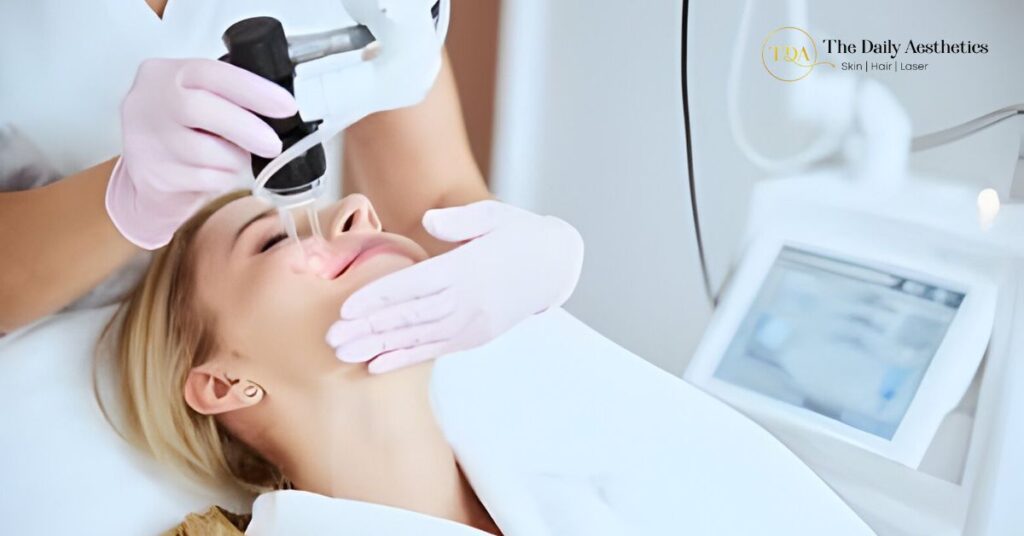
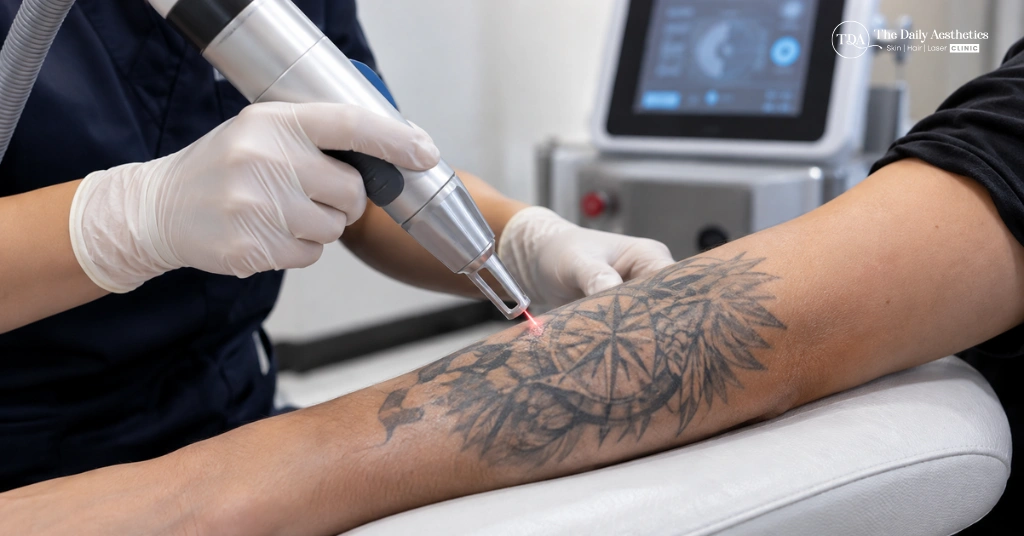
A laser tattoo removal session usually includes tattoo assessment, skin preparation, eye protection, laser treatment, cooling, dressing and aftercare instructions. The actual laser time may be short, but planning and aftercare are important because the skin still needs to heal properly after each session.
At The Daily Aesthetics Clinic, the tattoo removal journey is typically planned around the tattoo’s size, color, depth, skin tone, comfort level, and fading goal. Some patients want full removal, while others want fading before a cover-up tattoo.
- Assessment: the tattoo size, color, age, location, ink density, scarring and skin tone are reviewed.
- Preparation: the area is cleaned, comfort support may be discussed, and protective eye shields are used.
- Laser Pass: laser energy is delivered in controlled pulses to target tattoo pigment.
- Cooling And Dressing: the area may be cooled and covered according to the treatment plan.
- Aftercare: you receive instructions about cleansing, sun protection, avoiding picking, and follow-up timing.
The sensation is often described as a quick snapping or hot prickling feeling. Discomfort varies by area, tattoo density, individual sensitivity, and whether numbing support is used.
| Stage | What Happens | Why It Matters |
| Tattoo Assessment | The provider checks size, color, location, ink density, skin tone and previous scarring. | This helps estimate sessions and choose safer laser settings. |
| Skin Preparation | The area is cleaned and comfort measures may be used when appropriate. | Clean preparation lowers avoidable irritation risk. |
| Eye Protection | Protective eyewear is used during the laser session. | Laser safety is essential for every session. |
| Laser Treatment | Controlled pulses target tattoo pigment without treating the whole skin surface aggressively. | Precision supports fading while protecting surrounding skin. |
| Cooling And Aftercare | The treated skin is cooled, dressed and guided through aftercare. | Healing between sessions affects the final result. |
Note: The exact sequence may vary depending on tattoo area, skin condition, comfort needs and provider assessment.
Bottom Line: A good tattoo removal session is not just laser time; it includes assessment, safety planning and aftercare.
Which Tattoo Colors Are Easiest and Hardest to Remove?
Black and dark blue tattoos often respond better because darker pigments absorb laser energy more effectively. Colored tattoos can be more complex because different pigments respond to different wavelengths, and tattoo color and skin type both influence laser selection and treatment response.
This is one of the biggest reasons session count varies. A small black tattoo may fade predictably, while a colorful tattoo with green, yellow, white, orange or mixed ink may need more patience and may not clear evenly.
White and skin-colored inks can be especially unpredictable because they may darken or change shade after laser exposure. Cosmetic tattoos and permanent makeup also need careful evaluation because pigments can behave differently from standard tattoo ink.
| Tattoo Color | Usual Response Pattern | What To Ask Before Treatment |
| Black Or Dark Blue | Often responds more predictably than lighter colors. | How many sessions may be realistic for this ink density? |
| Red | May respond well with the correct wavelength but varies by pigment composition. | Is this red pigment suitable for the laser being used? |
| Green Or Blue-Green | Can be harder to fade and may require more sessions. | Will this color need different planning or a longer timeline? |
| Yellow, White Or Light Ink | Often unpredictable and may fade slowly or change tone. | Could this ink darken or leave a visible trace? |
| Multicolor Tattoo | Different colors may fade at different speeds. | Should the plan treat colors in stages? |
| Cosmetic Tattoo | May contain pigments that shift color during treatment. | Is a test spot or cautious approach needed? |
Note: Color response depends on pigment type, laser wavelength, ink depth, skin tone, and previous tattoo or laser history.
Bottom Line: A tattoo with more colors usually needs more careful planning than a simple black tattoo.
Have a Colored or Cover-Up Tattoo?
Colored, layered and cosmetic tattoos need a more cautious plan because every pigment may respond differently to laser energy.
Discuss Your Tattoo TypeHow Do Tattoo Size, Ink Depth and Age Affect Results?
Tattoo size, ink depth and tattoo age can strongly affect laser tattoo removal results. Smaller tattoos usually require less total laser coverage, dense ink may take longer to fragment, and older tattoos may already have faded partly through natural pigment breakdown over time.
A large tattoo does not only need more time per session. It may also need a more careful treatment plan because treating too much skin aggressively at once can increase swelling, blistering, discomfort, and aftercare demands.
Dense tattoos may need more sessions because the laser must work through a heavier pigment load. A shaded grey tattoo may fade differently from a solid black tribal tattoo, even when both are technically black ink.
Tattoo age matters too. Newer tattoos often hold more pigment and may need time before removal is considered. Older tattoos may have lighter pigment but can still be difficult if the ink sits deep or contains stubborn colors.
Do Professional, Amateur or Cover-Up Tattoos Fade Differently?
Yes, professional, amateur and cover-up tattoos often fade differently. Professional tattoos usually place ink more evenly and deeply, amateur tattoos may have irregular depth, and cover-up tattoos often have multiple pigment layers. This can change the number of sessions and the way fading appears.
Professional tattoos can be visually clean, but they often contain more saturated pigment. That may make them harder to clear completely than a lighter amateur tattoo, even when the professional tattoo looks sharper.
Amateur tattoos may be easier in some cases, but not always. Uneven ink depth can create patchy fading. Some areas may clear quickly, while other sections remain visible.
Cover-up tattoos are usually more complex because the laser has to work through both the newer visible tattoo and older underlying pigment. If scar tissue is present, results may be less predictable.
| Tattoo Type | Why It May Need More Or Fewer Sessions | Result Expectation |
| Small Amateur Tattoo | Ink may be lighter or shallower, but depth can be irregular. | Can fade well, though patchy fading is possible. |
| Professional Black Tattoo | Ink is often deeper, denser and more consistent. | May need a structured multi-session plan. |
| Large Color Tattoo | More surface area and multiple pigments increase complexity. | Fading may happen at different speeds by color. |
| Cover-Up Tattoo | Layered pigment and prior tattoo ink can remain underneath. | Often needs longer planning and realistic expectations. |
| Cosmetic Tattoo | Pigments may change color under laser exposure. | Cautious testing and specialist assessment may be needed. |
Note: Tattoo type is only one factor. Skin type, aftercare, location, previous procedures, and immune clearance also matter.
Bottom Line: The tattoo that looks simplest is not always the easiest to remove.
Does Skin Tone or Tattoo Location Change the Treatment Plan?
Skin tone and tattoo location both matter. In melanin-rich Indian skin, laser settings must be planned carefully because natural pigment can also absorb energy. Body areas with slower circulation, thicker skin, or more friction may fade more slowly and need extra aftercare attention.
For Pune patients, sun exposure is also a real factor. If the tattoo area is tanned, recently sunburned, irritated, scratched, or healing from another procedure, treatment may need to be delayed for safety.
Location affects fading because the body clears fragmented ink through natural processes. Areas closer to stronger circulation may respond differently from tattoos on the hands, feet, ankles, or lower legs.
- Face, neck or upper body tattoos may fade differently from hand, ankle or foot tattoos.
- Areas exposed to friction from shoes, clothing or gym gear may need stricter aftercare.
- Tanned or sun-exposed skin may have a higher risk of temporary pigment change.
- Existing scars, keloid tendency or texture change should be discussed before treatment.
- Darker skin tones often need conservative settings and careful spacing.
How Long Should You Wait Between Tattoo Removal Sessions?
Many laser tattoo removal plans space sessions roughly 6 to 8 weeks apart, but the right interval can vary. The goal is to give your skin time to settle and give your body time to clear fragmented ink before the next session is performed.
Rushing the interval is not always better. If redness, blistering, crusting, tenderness or pigmentation change is still present, another session may not be appropriate yet. Healing should guide timing as much as the calendar.
Some tattoos continue fading even several weeks after treatment. This is why reviewing photos over time can be useful. It helps your provider see whether the tattoo is responding, whether settings need adjustment, and whether the next session should proceed as planned.
Need a Realistic Tattoo Fading Timeline?
The team can review your tattoo type, color, location and skin tone to explain why your session gap should not be rushed.
Plan Your Session TimelineWhat Results Should You Expect After Each Session?
After each session, you may notice frosting, redness, swelling, warmth, tenderness, blistering, crusting or gradual fading. Some tattoos fade visibly after early sessions, while others change slowly. Tattoo removal may require several treatments and may not fully remove every tattoo.
This is where emotional expectations matter. Many people start removal because they are ready to close a chapter. When the tattoo is still visible after a few sessions, it can feel disappointing. That does not always mean the treatment has failed. It may simply mean the tattoo has deeper, denser or more resistant pigment.
Progress should be judged through comparison photos, not daily mirror checks. Skin can look temporarily red, swollen or darker during healing, so early judgment can be misleading.
| Timeline | What You May Notice | What To Remember |
| Immediately After | Whitening or frosting, warmth, redness and mild swelling may appear. | This early change is not the final result. |
| First Few Days | Tenderness, crusting, blistering or scabbing can happen depending on the tattoo and settings. | Do not pick, scratch or aggressively scrub the area. |
| Weeks 2 To 6 | The tattoo may slowly look lighter as the body clears pigment. | Fading often continues between sessions. |
| After Several Sessions | Lines may soften, shading may break up, and some colors may remain stronger. | Different colors can fade at different speeds. |
| End Of Treatment Course | The tattoo may be highly faded, partly cleared, or still have trace pigment. | Complete removal cannot be guaranteed for every tattoo. |
Note: Healing and fading timelines vary by tattoo characteristics, skin tone, lifestyle, aftercare, and treatment settings.
Bottom Line: Tattoo removal progress is usually measured in months, not days.
Is Laser Tattoo Removal Painful and What Side Effects Can Happen?
Laser tattoo removal can feel uncomfortable, but the sensation is usually brief because the laser portion of many sessions is quick. The treated area may feel warm, snapped, prickly, sore or sensitive. Comfort support can be discussed before treatment.
Side effects are usually temporary, but the skin still needs respect. Redness, swelling, tenderness, small blisters, crusting, temporary darkening, temporary lightening and texture change can happen. Scarring is uncommon when treatment and aftercare are appropriate, but it is still a possible risk.
Seek medical advice promptly if you notice increasing pain, spreading redness, pus, fever, severe swelling, unusual discoloration, or any sign that the area is not healing normally. Tattoo removal should not be treated like a casual beauty appointment if the skin is reacting strongly.
How Can You Improve Tattoo Removal Results Between Sessions?
You cannot force a tattoo to disappear faster, but you can support safer healing. Good aftercare, sun protection, not picking scabs, avoiding tanning, following the session interval, and sharing your medical history honestly can all help the treatment plan stay safer and more predictable.
Between sessions, your job is to protect the skin. Irritated, tanned or injured skin may need a delay, and delays are sometimes the safer choice. A rushed treatment on compromised skin can create more problems than progress.
- Avoid Sun Exposure: protect the tattoo area and avoid tanning before and after sessions.
- Do Not Pick Blisters Or Scabs: let healing happen naturally to reduce scarring risk.
- Follow Dressing Instructions: keep the area clean, dry and covered if advised.
- Avoid Harsh Products: do not apply acids, scrubs, bleaching creams or chemical removers unless advised.
- Share Health Changes: tell your provider about medications, allergies, infections or pregnancy before treatment.
- Take Progress Photos: consistent photos can help compare fading between sessions.
Can Laser Tattoo Removal Completely Remove a Tattoo?
Laser tattoo removal can significantly fade many tattoos, and some may clear very well, but complete removal is not guaranteed for every person. The final result depends on the ink, color, location, skin type, scarring, depth, response to laser, and how the skin heals.
This is an important expectation to set before starting. A responsible plan should discuss three possible goals: full removal, maximum fading, or fading enough for a better cover-up. Each goal may need a different timeline and different definition of success.
If your tattoo has white ink, green ink, layered pigment, pre-existing scarring, or previous poorly performed laser sessions, you may need a more cautious discussion about what is realistic.
How Do Sessions Affect Laser Tattoo Removal Cost in Pune?
Laser tattoo removal cost in Pune is usually influenced by the number of sessions, tattoo size, tattoo color, ink depth, technology used, treatment area, provider expertise and aftercare needs. Exact pricing should be discussed after the tattoo is assessed, not guessed from a photo alone.
This blog does not list prices because cost can vary widely from one tattoo to another. A small faded black tattoo and a large multicolored cover-up should not be priced or planned in the same way.
A useful consultation should explain what affects cost, what is included in the plan, how sessions are spaced, what aftercare is needed, and when progress will be reviewed.
Want Clear Cost Guidance Without Guesswork?
A consultation can help estimate how tattoo size, color, density and expected session count may affect your overall plan.
Request a Tattoo Removal ConsultationWhat Should You Ask Before Starting Laser Tattoo Removal in Pune?
Before starting laser tattoo removal in Pune, ask questions that reveal the clinic’s planning process, not just the package price. You should understand the laser used, expected sessions, risks for your skin tone, aftercare, session spacing, and realistic fading outcome.
A strong consultation should feel clear and calm. You should not feel pushed into a package before the tattoo has been properly assessed.
- Which laser will be used for my tattoo color and skin tone?
- How many sessions may be realistic for my tattoo, and why?
- Is my goal full removal or fading before a cover-up?
- What short-term reactions should I expect after treatment?
- How long should I wait between sessions?
- What aftercare should I follow at home?
- What signs mean I should contact the clinic after a session?
- Can my tattoo leave a shadow, pigment change or texture change after removal?
Why Choose The Daily Aesthetics Clinic for Laser Tattoo Removal in Pune?
The Daily Aesthetics Clinic offers tattoo removal care across Kalyani Nagar, Kharadi and Baner, with a consultation-led approach for people who want safe fading, realistic expectations and guided aftercare. The clinic’s tattoo removal service uses Q-Switched Nd:YAG laser technology for suitable tattoos and plans sessions according to tattoo and skin factors.
The Daily Aesthetics Clinic is especially relevant if you are trying to understand why your tattoo may need several sessions, whether a colored tattoo can be faded, how Indian skin tone may affect laser planning, or whether your goal should be complete removal or partial fading before a cover-up.
Your treatment plan should review tattoo characteristics, ink depth, location, skin tone, immune clearance, aftercare, session spacing and realistic expectations before the first laser session begins.
Patients can visit the nearest Pune clinic:
- Kalyani Nagar: Plot 17, Lane No. 7, next to Hotel Sudharshan, opposite Lunkad Sky Lounge, Kalyani Nagar, Pune, Maharashtra 411006. Phone: +91 96738 58066.
- Kharadi: Shop No. 120, Gera Imperial, Rajaram Patil Nagar, Vittal Nagar, Kharadi, Pune, Maharashtra 411014. Phone: +91 97685 55421.
- Baner: Shop No. 11, A-wing, SR. No. 32, Sterling Tower, Off Pancard Club Road, Baner, Pune, Maharashtra 411045. Phone: +91 91585 80123.
Ready to Plan Your Tattoo Removal Safely?
Visit The Daily Aesthetics Clinic in Kalyani Nagar, Kharadi or Baner for a tattoo assessment and realistic session plan.
Find Your Nearest Pune ClinicConclusion
Laser tattoo removal is not only about the laser. It is about the tattoo, the ink, your skin tone, your healing response, your expectations and how carefully each session is spaced and reviewed.
Most people should expect multiple sessions. Black, small, older or lighter-density tattoos may fade more predictably, while colored, large, professional, layered, cover-up or scarred tattoos often need more time and patience.
At The Daily Aesthetics Clinic, the focus is to help you understand your tattoo before you commit to treatment. When the plan is based on assessment instead of guesswork, the process feels clearer, safer and more realistic.
Start With a Tattoo Assessment in Pune
Speak with the team at The Daily Aesthetics Clinic to understand your session estimate, fading expectations and aftercare plan.
Book Your Laser Tattoo Removal ConsultationFrequently Asked Questions
1. How Many Sessions Do You Need for Laser Tattoo Removal?
Many people need around 5 to 10 sessions, but the exact number depends on tattoo color, size, age, ink depth, density, location, skin tone and healing response. Some tattoos need fewer sessions, while large, colored or layered tattoos may need more.
2. Can a Tattoo Be Removed in One Laser Session?
One session is usually not enough for complete tattoo removal. A single session may start fading the tattoo, but the body needs time to clear broken ink particles and most tattoos need repeated treatments.
3. Why Is My Tattoo Not Fading After Several Sessions?
Slow fading can happen when the tattoo has dense ink, resistant colors, deep pigment, layering, scarring, poor aftercare or short session intervals. Your provider may need to review photos, adjust the plan, or explain whether full removal is realistic.
4. Which Tattoo Colors Are Hardest to Remove?
Green, yellow, white, light blue, orange and some mixed pigments can be harder to remove than black ink. Color response depends on pigment type, wavelength selection, skin tone and how the tattoo was placed.
5. Are Old Tattoos Easier to Remove Than New Tattoos?
Older tattoos may be easier in some cases because they have already faded naturally over time. However, an old tattoo can still be difficult if it is dense, deep, colorful, layered or scarred.
6. Does Laser Tattoo Removal Leave Scars?
Scarring is possible but less likely when treatment is planned carefully and aftercare is followed. Picking scabs, tanning, treating irritated skin, aggressive settings or poor healing can increase the risk.
7. How Long Should I Wait Between Tattoo Removal Sessions?
Many treatment plans leave about 6 to 8 weeks between sessions, but timing should depend on healing and provider guidance. Treating too soon can irritate the skin and may not improve clearance.
8. Is Q-Switched Nd:YAG Laser Good for Tattoo Removal?
Q-Switched Nd:YAG laser is commonly used for tattoo pigment, especially darker inks, and can be suitable for many Indian skin tones when settings are chosen carefully. Suitability depends on tattoo color, skin type, medical history and treatment goals.
9. Can Laser Tattoo Removal Completely Remove a Tattoo?
Some tattoos clear very well, but complete removal is not guaranteed. A tattoo may fade significantly while still leaving a faint shadow, trace pigment, texture change or color residue.
The Daily Aesthetics Clinic – Redefining Skin & Hair Treatments in Pune
The Daily Aesthetics Clinic is a trusted dermatology and aesthetic center in Pune, offering advanced treatments for acne, pigmentation, hair loss, laser hair removal, Hydrafacials, hair transplants, and personalized skincare.
Under the guidance of Dr. Arshi Rahul, the clinic combines medical expertise with FDA-approved technology to deliver customized treatment plans that focus on restoring skin health, enhancing radiance, and ensuring every patient feels confident and cared for.
With the trust of over 3,500 patients and a 4.9★ rating, The Daily Aesthetics Clinic is known for delivering effective, safe, and personalized care in a calm, welcoming setting.
We serve clients across Pune through our three conveniently located clinics in Baner, Kharadi, and Kalyani Nagar.
Read More:
- Skin Laser Treatment in Pune: Cost, Benefits & Results
- CO2 Laser Treatment: Understanding Costs, Benefits, and Potential Side Effects
- Is Laser Treatment Safe for Darker Skin Tones? A Trusted Dermatologist in Pune Explains