

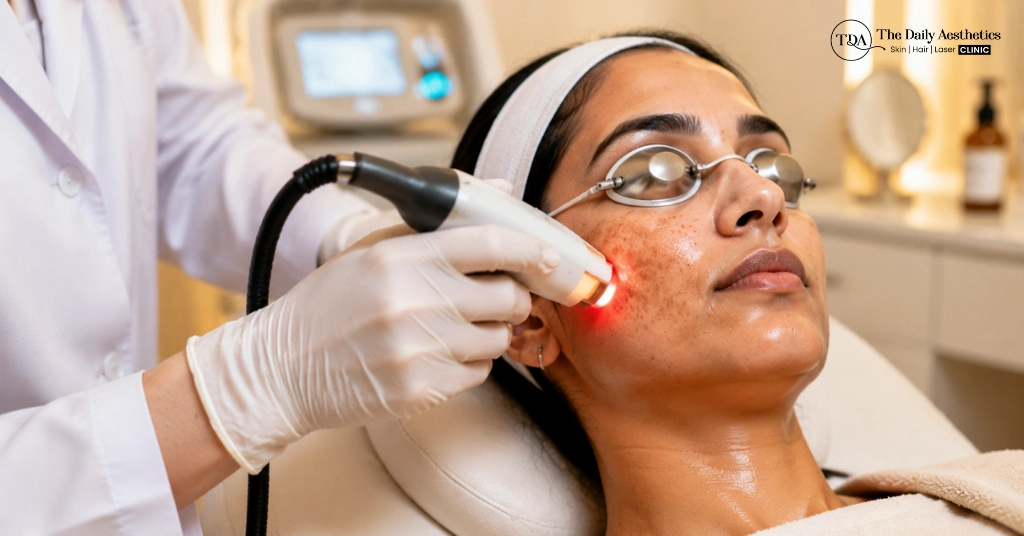
How to Reduce Melanin in Skin: Safe Dermatologist-Backed Methods
If you have been searching how to reduce melanin in skin, you are probably not chasing a lighter complexion. You are most likely trying to fade a stubborn patch of melasma, an old acne mark that refuses to budge, sun spots that crept in after summer, or an uneven tone that makeup can no longer hide. Melanin is not the enemy. It is your skin’s built-in shield against UV damage. The real goal is to calm the overproduction of melanin in specific areas so your skin looks even, healthy, and clear. Done right, this is pigmentation correction, not skin whitening. Most people think reducing melanin means bleaching the skin. It is about correcting the trigger and rebalancing pigment in problem areas. The Daily Aesthetics (TDA), Pune’s leading aesthetic clinic with locations in Kharadi, Baner, and Kalyani Nagar, builds pigmentation plans around your Fitzpatrick skin type, your trigger, and your lifestyle, never a one-size-fits-all bleaching pitch. In this guide, you will learn what causes excess melanin, the four pillars of safe melanin reduction, the topical and in-office treatments dermatologists actually use, what to avoid, and how long results realistically take. Key Takeaways What Is Melanin and Why Does It Increase? Melanin is the pigment that gives your skin, hair, and eyes their color. It is produced by cells called melanocytes through a process called melanogenesis, which depends on an enzyme named tyrosinase. Everyone has roughly the same number of melanocytes, but how much pigment they release, and how that pigment is distributed, differs from person to person. When something triggers melanocytes to work overtime, you get hyperpigmentation. Common triggers include: Understanding the trigger is the first step, because the treatment plan depends on it. The Fitzpatrick Scale: Why Skin Tone Matters Dermatologists classify skin tones I (very fair, always burns) through VI (deeply pigmented, never burns) on the Fitzpatrick scale. For Indian and South Asian patients, the most common phototypes are IV and V, and this matters enormously for treatment. Higher Fitzpatrick types have more reactive melanocytes. That means aggressive peels, the wrong laser wavelength, or even overzealous exfoliation can trigger more pigmentation than they remove. Safe melanin reduction in skin of color almost always means longer laser wavelengths (1064 nm Nd:YAG), gentler peel acids at lower percentages, and strict sun protection that includes visible light. Pillar 1: Sun Protection (The Non-Negotiable Foundation) If you do nothing else, do this. Without daily, generous sunscreen, every other treatment on this list is wasted. The American Academy of Dermatology recommends a broad-spectrum, water-resistant sunscreen with SPF 30 or higher, which blocks roughly 97% of UVB rays. Reapply every two hours outdoors, and after sweating or swimming. For Fitzpatrick IV to VI and anyone with melasma or PIH, tinted sunscreens containing iron oxides are essential. A 2020 study by Dumbuya and colleagues in the Journal of Drugs in Dermatology demonstrated that iron-oxide-containing formulations significantly protected against visible-light-induced pigmentation in Fitzpatrick IV individuals, while a mineral SPF 50+ sunscreen alone gave results similar to untreated skin. The takeaway: SPF number alone does not protect skin of color from melasma triggers. You need the iron oxide tint. Add wide-brimmed hats, UV-blocking sunglasses, and seek shade between 10 a.m. and 4 p.m. for full coverage. Not Sure Which Pigmentation Concern You Have? Get a personalized assessment from the experts at The Daily Aesthetics before spending on treatments or products that may not suit your skin type or pigmentation concern. Book a Skin Pigmentation Consultation Pillar 2: Topical Treatments That Work Topicals are the workhorse of melanin reduction. Most work by inhibiting tyrosinase, blocking melanosome transfer, or speeding cell turnover. Hydroquinone (Prescription Only in the US) Long considered the gold standard for hyperpigmentation, hydroquinone is highly effective at 2% to 4% concentrations. In April 2022, the FDA issued warning letters to 12 companies stating that no OTC hydroquinone product is generally recognized as safe and effective. The only FDA-approved hydroquinone product remains Tri-Luma, a prescription combination for short-term (up to eight weeks) treatment of moderate-to-severe facial melasma. Long-term unsupervised use can cause ochronosis, a permanent blue-black skin discoloration, which is exactly why dermatologist supervision matters. Tretinoin and Retinoids Tretinoin accelerates cell turnover, exfoliating pigmented cells and improving the penetration of other actives. It is commonly combined with hydroquinone and a low-potency corticosteroid in the modified Kligman’s formula. Azelaic Acid A gentler, pregnancy-safe option that inhibits tyrosinase and reduces inflammation. Excellent for PIH and rosacea-related pigmentation in skin of color. Vitamin C (L-Ascorbic Acid) A potent antioxidant that brightens, blocks tyrosinase, and protects against UV-induced free radicals. Look for 10% to 20% L-ascorbic acid serums applied in the morning before sunscreen. Niacinamide (Vitamin B3) Niacinamide reduces pigmentation by inhibiting melanosome transfer from melanocytes to keratinocytes. In a landmark study by Hakozaki and colleagues published in the British Journal of Dermatology in 2002, 5% niacinamide produced 35% to 68% inhibition of melanosome transfer, with clinical trials showing significant decreases in hyperpigmentation after four weeks of use. Niacinamide is well-tolerated even on sensitive skin. Tranexamic Acid (Topical and Oral) A newer star in melasma treatment. Topical 5% tranexamic acid has shown efficacy comparable to 4% hydroquinone in clinical comparisons. Oral tranexamic acid is an effective off-label option for refractory melasma; in a retrospective analysis by Lee, Thng and Goh published in the Journal of the American Academy of Dermatology in 2016, 89.7% of 561 patients improved on oral tranexamic acid, with response typically seen within two months. Oral use requires screening for clotting risk factors and is not appropriate during pregnancy. Cysteamine An aminothiol with antioxidant and depigmenting properties. A 2024 meta-analysis published in PMC found cysteamine 5% cream comparable in efficacy to hydroquinone-based regimens, with a favorable safety profile for longer-term use. Alpha Arbutin, Kojic Acid, Glycolic Acid, Lactic Acid These ingredients support brightening by inhibiting tyrosinase (arbutin, kojic acid) or gently exfoliating pigmented cells (glycolic and lactic acid). They work best as supporting activities rather than primary treatments. Pillar 3: In-Office Procedures at TDA When topicals plateau, professional procedures can take results to the next level. At TDA, every procedure is selected based on your Fitzpatrick type, the depth of pigment (epidermal versus dermal), and your lifestyle. Chemical Peels Chemical peels exfoliate the upper layers of skin where pigment sits. Peel Type Best For Notes Glycolic acid (20% to 70%) Superficial epidermal pigmentation Series of 4 to 6 sessions Salicylic acid (20% to 30%) Acne-related
How to Reduce Melanin in Skin: Safe Dermatologist-Backed Methods Read More »
Skin, Skin Clinic, skin specialist