


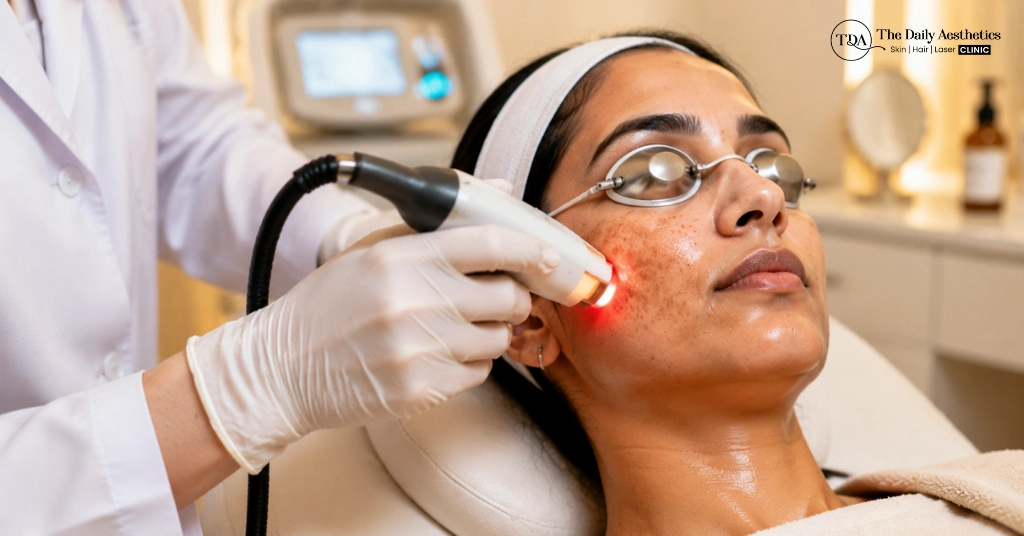
If you have been searching how to reduce melanin in skin, you are probably not chasing a lighter complexion.
You are most likely trying to fade a stubborn patch of melasma, an old acne mark that refuses to budge, sun spots that crept in after summer, or an uneven tone that makeup can no longer hide.
Melanin is not the enemy. It is your skin’s built-in shield against UV damage. The real goal is to calm the overproduction of melanin in specific areas so your skin looks even, healthy, and clear.
Done right, this is pigmentation correction, not skin whitening.
Most people think reducing melanin means bleaching the skin. It is about correcting the trigger and rebalancing pigment in problem areas.
The Daily Aesthetics (TDA), Pune’s leading aesthetic clinic with locations in Kharadi, Baner, and Kalyani Nagar, builds pigmentation plans around your Fitzpatrick skin type, your trigger, and your lifestyle, never a one-size-fits-all bleaching pitch.
In this guide, you will learn what causes excess melanin, the four pillars of safe melanin reduction, the topical and in-office treatments dermatologists actually use, what to avoid, and how long results realistically take.
Table of Contents
ToggleKey Takeaways
- Melanin protects your skin from UV damage; the goal is not to eliminate it, but to correct uneven, excess pigment caused by sun, hormones, inflammation, or genetics.
- The four pillars of safe melanin reduction are daily broad-spectrum SPF 30+ with iron oxides, dermatologist-prescribed topicals, in-office procedures, and lifestyle support.
- Hydroquinone is effective but is now prescription-only in the US after FDA action in April 2022, and should always be used under medical supervision.
- Skin of color (Fitzpatrick IV to VI) needs gentler protocols and longer laser wavelengths to avoid post-inflammatory hyperpigmentation (PIH).
- Avoid mercury creams, illegal high-strength bleaches, and unsupervised glutathione injections; the WHO and FDA have warned against these.
- Visible results take 8 to 16 weeks of consistent care, and melanin can return without ongoing sun protection.
What Is Melanin and Why Does It Increase?
Melanin is the pigment that gives your skin, hair, and eyes their color.
It is produced by cells called melanocytes through a process called melanogenesis, which depends on an enzyme named tyrosinase.
Everyone has roughly the same number of melanocytes, but how much pigment they release, and how that pigment is distributed, differs from person to person.
When something triggers melanocytes to work overtime, you get hyperpigmentation. Common triggers include:
- UV and visible light exposure: The single biggest driver. Even visible light from screens and the high-energy visible spectrum stimulates melanocytes, especially in deeper skin tones.[Text Wrapping Break]
- Hormones (melasma): Pregnancy, oral contraceptives, and hormone replacement therapy can trigger symmetrical brown patches on the cheeks, forehead, and upper lip. An international survey of nearly 48,000 respondents published in the Journal of the American Academy of Dermatology in 2024 found 11% reported melasma, with 68% of those affected being women and a mean age of 41 years.[Text Wrapping Break]
- Post-inflammatory hyperpigmentation (PIH): Acne, eczema, cuts, burns, and even harsh scrubbing leave dark marks. The Skin of Color Society notes that more than 65% of African Americans experience PIH symptoms, and the prevalence is similarly high among South Asian, East Asian, and Hispanic populations.[Text Wrapping Break]
- Medications: Certain antibiotics, NSAIDs, and chemotherapy drugs can darken skin.[Text Wrapping Break]
- Genetics: Family history strongly predisposes you to melasma and freckling.
Understanding the trigger is the first step, because the treatment plan depends on it.
The Fitzpatrick Scale: Why Skin Tone Matters
Dermatologists classify skin tones I (very fair, always burns) through VI (deeply pigmented, never burns) on the Fitzpatrick scale.
For Indian and South Asian patients, the most common phototypes are IV and V, and this matters enormously for treatment.
Higher Fitzpatrick types have more reactive melanocytes. That means aggressive peels, the wrong laser wavelength, or even overzealous exfoliation can trigger more pigmentation than they remove.
Safe melanin reduction in skin of color almost always means longer laser wavelengths (1064 nm Nd:YAG), gentler peel acids at lower percentages, and strict sun protection that includes visible light.
Pillar 1: Sun Protection (The Non-Negotiable Foundation)
If you do nothing else, do this. Without daily, generous sunscreen, every other treatment on this list is wasted.
The American Academy of Dermatology recommends a broad-spectrum, water-resistant sunscreen with SPF 30 or higher, which blocks roughly 97% of UVB rays.
Reapply every two hours outdoors, and after sweating or swimming.
For Fitzpatrick IV to VI and anyone with melasma or PIH, tinted sunscreens containing iron oxides are essential. A 2020 study by Dumbuya and colleagues in the Journal of Drugs in Dermatology demonstrated that iron-oxide-containing formulations significantly protected against visible-light-induced pigmentation in Fitzpatrick IV individuals, while a mineral SPF 50+ sunscreen alone gave results similar to untreated skin.
The takeaway: SPF number alone does not protect skin of color from melasma triggers. You need the iron oxide tint.
Add wide-brimmed hats, UV-blocking sunglasses, and seek shade between 10 a.m. and 4 p.m. for full coverage.
Not Sure Which Pigmentation Concern You Have?
Get a personalized assessment from the experts at The Daily Aesthetics before spending on treatments or products that may not suit your skin type or pigmentation concern.
Book a Skin Pigmentation ConsultationPillar 2: Topical Treatments That Work
Topicals are the workhorse of melanin reduction. Most work by inhibiting tyrosinase, blocking melanosome transfer, or speeding cell turnover.
Hydroquinone (Prescription Only in the US)
Long considered the gold standard for hyperpigmentation, hydroquinone is highly effective at 2% to 4% concentrations.
In April 2022, the FDA issued warning letters to 12 companies stating that no OTC hydroquinone product is generally recognized as safe and effective.
The only FDA-approved hydroquinone product remains Tri-Luma, a prescription combination for short-term (up to eight weeks) treatment of moderate-to-severe facial melasma.
Long-term unsupervised use can cause ochronosis, a permanent blue-black skin discoloration, which is exactly why dermatologist supervision matters.
Tretinoin and Retinoids
Tretinoin accelerates cell turnover, exfoliating pigmented cells and improving the penetration of other actives.
It is commonly combined with hydroquinone and a low-potency corticosteroid in the modified Kligman’s formula.
Azelaic Acid
A gentler, pregnancy-safe option that inhibits tyrosinase and reduces inflammation. Excellent for PIH and rosacea-related pigmentation in skin of color.
Vitamin C (L-Ascorbic Acid)
A potent antioxidant that brightens, blocks tyrosinase, and protects against UV-induced free radicals. Look for 10% to 20% L-ascorbic acid serums applied in the morning before sunscreen.
Niacinamide (Vitamin B3)
Niacinamide reduces pigmentation by inhibiting melanosome transfer from melanocytes to keratinocytes. In a landmark study by Hakozaki and colleagues published in the British Journal of Dermatology in 2002, 5% niacinamide produced 35% to 68% inhibition of melanosome transfer, with clinical trials showing significant decreases in hyperpigmentation after four weeks of use.
Niacinamide is well-tolerated even on sensitive skin.
Tranexamic Acid (Topical and Oral)
A newer star in melasma treatment. Topical 5% tranexamic acid has shown efficacy comparable to 4% hydroquinone in clinical comparisons.
Oral tranexamic acid is an effective off-label option for refractory melasma; in a retrospective analysis by Lee, Thng and Goh published in the Journal of the American Academy of Dermatology in 2016, 89.7% of 561 patients improved on oral tranexamic acid, with response typically seen within two months.
Oral use requires screening for clotting risk factors and is not appropriate during pregnancy.
Cysteamine
An aminothiol with antioxidant and depigmenting properties.
A 2024 meta-analysis published in PMC found cysteamine 5% cream comparable in efficacy to hydroquinone-based regimens, with a favorable safety profile for longer-term use.
Alpha Arbutin, Kojic Acid, Glycolic Acid, Lactic Acid
These ingredients support brightening by inhibiting tyrosinase (arbutin, kojic acid) or gently exfoliating pigmented cells (glycolic and lactic acid).
They work best as supporting activities rather than primary treatments.
Pillar 3: In-Office Procedures at TDA
When topicals plateau, professional procedures can take results to the next level.
At TDA, every procedure is selected based on your Fitzpatrick type, the depth of pigment (epidermal versus dermal), and your lifestyle.
Chemical Peels
Chemical peels exfoliate the upper layers of skin where pigment sits.
| Peel Type | Best For | Notes |
| Glycolic acid (20% to 70%) | Superficial epidermal pigmentation | Series of 4 to 6 sessions |
| Salicylic acid (20% to 30%) | Acne-related PIH, oily skin | Safe across most skin tones |
| Jessner’s solution | Moderate, mixed hyperpigmentation | Stronger; needs experience |
| TCA (10% to 35%) | Deeper pigment, sun damage | Lower Fitzpatrick types only |
| Mandelic / lactic acid | Skin of color (IV to VI) | Larger molecules, lower PIH risk |
A series of 4 to 6 peels spaced 2 to 4 weeks apart, paired with home topicals and SPF, delivers visible results.
Read more on our Chemical Peel Treatment page, or see our complete cost, benefits, and results breakdown for a deeper dive.
Laser Treatments
Lasers target melanin directly with light energy, fragmenting pigment so the body can clear it.
- Q-switched Nd:YAG 1064 nm: The safest workhorse for Fitzpatrick IV to VI. Its longer wavelength bypasses surface melanin and targets deeper pigment with less risk of PIH.
- Picosecond lasers (755 nm and 1064 nm): Deliver ultrashort pulses that shatter pigment into finer particles, often requiring fewer sessions.
- Fractional non-ablative lasers: Stimulate collagen and improve mixed pigmentation and texture.
- IPL (intense pulsed light): Works well for Fitzpatrick I to III but is generally not recommended for IV to VI due to PIH risk.
Explore our full range on the Skin Laser Treatment page.
Microneedling
Tiny needles create micro-channels that boost collagen and enhance the penetration of brightening serums like tranexamic acid, vitamin C, and PRP.
Especially helpful for PIH, acne scars, and melasma when paired with the right topicals.
Microdermabrasion
A minimally invasive exfoliation that polishes the upper layer of skin and supports overall brightness.
Best as a supporting treatment rather than a standalone solution.
Curious Which Laser or Peel Suits Your Skin Type?
Speak with the experts at The Daily Aesthetics to understand which treatments are safest and most effective for your pigmentation, melasma, or uneven skin tone.
Talk to a Skin SpecialistPillar 4: Lifestyle and Diet
Internal health shows on the skin.
- Antioxidant-rich diet: Vitamin C-rich fruits, leafy greens, green tea (EGCG), tomatoes (lycopene), and berries support melanin balance and fight oxidative stress.
- Hydration: 8 to 10 glasses of water daily supports cell turnover.
- Sleep: 7 to 9 hours nightly is when your skin repairs and renews.
- Stress management: Chronic stress raises cortisol, which can worsen melasma and PIH.
- Avoid heat triggers: Saunas, very hot showers, and excessive sweating can flare melasma.
What NOT to Do: Dangerous Practices to Avoid
The global skin lightening industry is enormous.
According to Grand View Research, the market was valued at USD 11.20 billion in 2023 and is projected to reach USD 16.14 billion by 2030.
With that growth comes risk, and unsafe shortcuts are everywhere.
Mercury-Containing Creams
Banned by the FDA and regulated globally under the Minamata Convention on Mercury.
Mercury can cause kidney damage, neurological harm, immune dysfunction, and permanent skin discoloration.
A 2018 report by the Zero Mercury Working Group and UNEP tested 338 skin-lightening creams from 22 countries and found 10% had mercury concentrations ranging from 93 to 16,353 ppm, far above the 1 ppm legal limit.
Avoid any product with handwritten labels, unclear ingredient lists, or no English labeling.
Illegal Over-the-Counter Hydroquinone in the US
The FDA’s April 2022 warning letters made clear that no OTC hydroquinone product is legally marketed in the United States. Prescription supervision is essential to prevent ochronosis.
Unsupervised Glutathione Injections
IV glutathione is widely marketed for skin whitening, but it is not FDA-approved for that purpose. Documented adverse events include liver dysfunction, anaphylaxis, Stevens-Johnson syndrome, and toxic epidermal necrolysis.
When TDA offers glutathione, it is administered only after full medical screening, by qualified physicians, using pharmaceutical-grade product.
Aggressive DIY Treatments
Lemon juice, baking soda, and unverified turmeric scrubs commonly cause photosensitivity, chemical burns, and worsening PIH. Skip them.
Ignoring Sunscreen
The single biggest mistake. Without daily SPF, every treatment regresses.
Already Tried Creams That Did Not Work or Made Pigmentation Worse?
Get an expert evaluation from The Daily Aesthetics and understand what your skin truly needs for safe, effective, and long-term pigmentation correction.
Schedule a Skin AssessmentA Note on Cultural Framing
This guide is not about making your skin lighter than it naturally is. It is about restoring an even tone, fading patches of unwanted pigment, and protecting the skin you already have.
Darker skin is not a flaw to be corrected. It carries built-in UV protection, slower visible aging, and unique beauty.
The goal here is confidence in your skin, whatever your Fitzpatrick type.
Realistic Timeline: When Will You See Results?
| Timeframe | What to Expect |
| Weeks 1 to 4 | Sunscreen and topicals start preventing new pigment |
| Weeks 4 to 8 | Visible brightening; first peel or laser results appear |
| Weeks 8 to 16 | Significant fading of existing pigment with consistent care |
| Months 4 to 12 | Maximum results; melasma may need ongoing maintenance |
Patience matters. Skin cells take roughly 28 days to turn over, and deeper dermal pigment takes longer.
Conclusion
Reducing melanin safely is not about chasing a shade. It is about understanding your trigger, treating it with evidence-based methods, and protecting your results.
Sunscreen is non-negotiable. Topicals work, but take patience. In-office procedures accelerate results when chosen correctly for your skin type. And shortcuts like mercury creams, illegal bleaches, and unsupervised injections often cause more harm than the original concern.
The Daily Aesthetics has helped thousands of patients across Pune fade pigmentation safely with treatments tailored to their Fitzpatrick type and lifestyle. The team is led by aesthetic physicians trained in lasers, peels, and prescription topicals, and every plan starts with a conversation about your trigger, not a sales pitch.
Healthy, even-toned skin is achievable. It just requires the right plan and the right partner.
Ready to Start Your Pigmentation Treatment Journey?
Book a one-on-one consultation with the experts at The Daily Aesthetics and receive a clear, safe, and personalized treatment plan for your skin concerns.
Book Your Consultation at TDAFrequently Asked Questions (FAQs)
1. Can you permanently reduce melanin in skin?
No. Melanin is essential and is regulated by genetics. You can reduce excess pigment and maintain results with consistent sun protection and maintenance treatments, but your underlying ability to produce melanin stays intact, which is a good thing for skin health and cancer prevention.
2. Does melanin come back after treatment?
Yes, especially with sun exposure or hormonal triggers. Melasma is particularly recurrent. This is why dermatologists emphasize maintenance: daily SPF, periodic touch-up treatments, and ongoing topical use.
3. How long does it take to reduce melanin?
Most patients see noticeable improvement within 8 to 12 weeks of consistent care. Deeper melasma and dermal pigment can take 4 to 6 months.
4. What is the best treatment for hyperpigmentation in darker skin tones?
A combination approach: strict sun protection with iron-oxide tinted SPF 30+, topical tranexamic acid or azelaic acid, gentle peels (mandelic, low-percentage glycolic), and Q-switched 1064 nm Nd:YAG laser when needed. Avoid IPL and aggressive ablative lasers for Fitzpatrick V and VI.
5. Is hydroquinone safe?
Yes, when used short-term (typically 8 to 12 weeks) under a dermatologist’s supervision. Long-term unsupervised use can cause ochronosis. Since April 2022, the FDA has not allowed OTC sales in the US; the only legal hydroquinone product is the prescription Tri-Luma.
6. Can diet alone reduce melanin?
Diet supports skin health but does not significantly fade established pigment. Think of it as a 10 to 15% contribution to your overall results, valuable but not a standalone solution.
7. Are lasers safe for Indian and South Asian skin?
Yes, with the right wavelength and settings. Q-switched 1064 nm Nd:YAG and certain picosecond platforms are well-studied in Fitzpatrick III to V skin. Always choose a clinic experienced with skin of color, as wrong settings can trigger more pigmentation than they remove.
The Daily Aesthetics Clinic – Redefining Skin & Hair Treatments in Pune
The Daily Aesthetics Clinic is a trusted dermatology and aesthetic center in Pune, offering advanced treatments for acne, pigmentation, hair loss, laser hair removal, Hydrafacials, hair transplants, and personalized skincare.
Under the guidance of Dr. Arshi Rahul, the clinic combines medical expertise with FDA-approved technology to deliver customized treatment plans that focus on restoring skin health, enhancing radiance, and ensuring every patient feels confident and cared for.
With the trust of over 3,500 patients and a 4.9★ rating, The Daily Aesthetics Clinic is known for delivering effective, safe, and personalized care in a calm, welcoming setting.
We serve clients across Pune through our three conveniently located clinics in Baner, Kharadi, and Kalyani Nagar.
Read More:

Dr. Arshi Rahul
Aesthetic Physician & Skin Specialist | 11+ years of experience
Expert Dermo-Cosmetologist & Trichologist (Gold Coast Training Academy, Australia) | Certified in Laser, Botox, Fillers & Thread Lifting | Over 10 Years of Advanced Aesthetic Expertise