


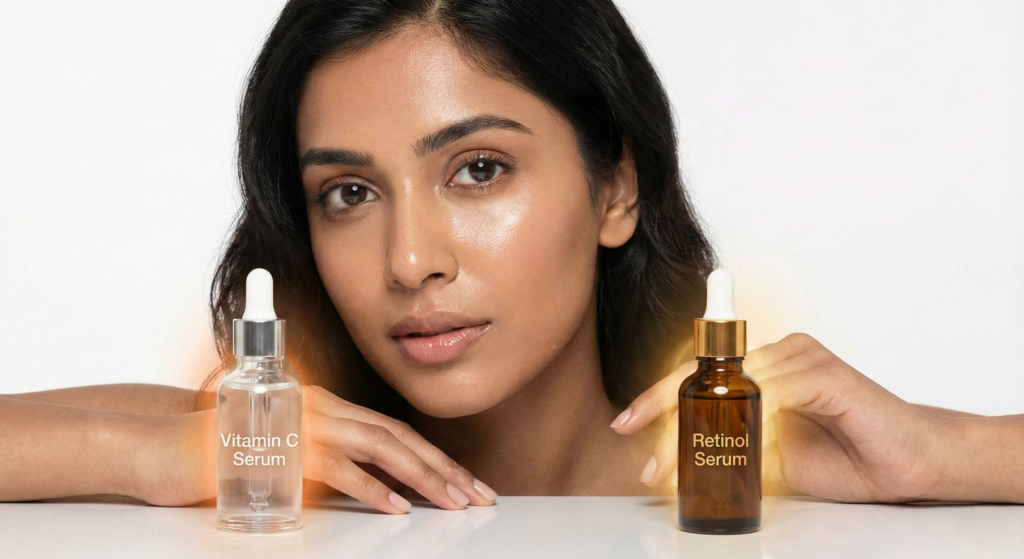
Key Takeaways
Vitamin C: The Morning Protector
-
Primary Goal: It acts as a shield against environmental damage.
-
Best For: Brightening dull complexions, fading dark spots (pigmentation), and protecting against pollution and UV rays.
-
When to Apply: Use in the Morning (AM) to defend your skin throughout the day.
Retinol: The Nighttime Corrector
-
Primary Goal: It accelerates cell turnover to renew the skin from within.
-
Best For: Reducing fine lines and wrinkles, smoothing rough texture, and boosting collagen production.
-
When to Apply: Use at Night (PM), as it is powerful and sensitive to sunlight.
The Final Verdict
- Compatibility: You do not have to choose just one. The most effective anti-aging routine often includes Vitamin C in the morning and Retinol at night to get the best of both worlds.
You probably hear a lot about anti-aging skincare.
There are serums, creams, oils, and treatments everywhere you look, and each one promises smoother, brighter, younger-looking skin.
It can feel confusing when you try to decide what your skin needs. Maybe you have held a vitamin C serum in one hand and a retinol cream in the other and wondered which one will help you get the best results.
Vitamin C and retinol are two of the most researched and trusted ingredients in skincare. They both help improve signs of aging, but they work in completely different ways.
When you understand what they do and how they interact with your skin, it becomes much easier to choose the right one for your routine.
In this guide, you will explore how each ingredient works, what benefits they offer, and how to decide which one fits your skin goals.
By the end, you will know whether vitamin C, retinol, or a combination of both is the best choice for you.
Table of Contents
ToggleWhat Is Vitamin C?
When you see vitamin C in skincare, it often refers to ascorbic acid.
This is the purest and most active form of vitamin C.
It works well, but it can be unstable when exposed to light, air, or heat.
Because of this, many brands create vitamin C derivatives that are more stable and easier for sensitive skin to tolerate.
Examples include sodium ascorbyl phosphate, magnesium ascorbyl phosphate, and tetrahexyldecyl ascorbate. These versions may not be as strong as pure ascorbic acid, but they can still brighten your skin and provide antioxidant benefits.
How Vitamin C Benefits the Skin
Vitamin C is a powerful ingredient with several important benefits.
It protects your skin from free radicals. Free radicals form from sun exposure, pollution, and everyday stress. They damage skin cells and speed up aging. Vitamin C helps neutralize them.
It supports collagen production. Collagen keeps your skin firm and youthful. Vitamin C helps your body build and maintain this important protein.
It brightens your skin tone. Vitamin C helps fade dark spots by slowing down the process that produces pigmentation.
It helps defend your skin from environmental stress. Vitamin C can reduce the effects of UV exposure and pollution.
Pros of Vitamin C
- It gives your skin a healthy glow with consistent use.
- It works well for daily protection against environmental damage.
- Many skin types tolerate it well.
- It helps prevent early signs of aging before they become noticeable.
Cons of Vitamin C
- Pure ascorbic acid is unstable and can lose effectiveness if not stored correctly.
- Higher concentrations may cause redness or tingling.
- Some products may not be strong or stable enough to deliver results.
Who Vitamin C Works Best For
Vitamin C is a great choice if you want brighter skin, fewer dark spots, and support for early signs of aging. It is also ideal if you want daily antioxidant protection to keep your skin looking fresh and healthy.
What Is Retinol?
Retinol belongs to the retinoid family, which is a group of ingredients made from vitamin A.
When you apply retinol to your skin, your body slowly converts it into retinoic acid. Retinoic acid is the active form that creates visible changes in your skin.
This explains why retinol works gradually and becomes more effective over time.
There are other types of retinoids, too. For example, retinaldehyde converts more quickly into retinoic acid, and prescription tretinoin converts instantly.
These stronger forms can deliver faster results but often come with higher chances of irritation.
How Retinol Benefits the Skin
Retinol is one of the most powerful ingredients in skincare because it improves your skin in several important ways.
- It increases cell turnover. This means your skin sheds old cells more efficiently and reveals fresher, smoother skin underneath.
- It boosts collagen production. More collagen creates firmer and more youthful-looking skin and helps soften fine lines and wrinkles.
- It improves texture and tone. Retinol can reduce rough patches, soften fine lines, and make your skin feel more even and refined.
Pros of Retinol
- It is one of the most effective ingredients for visible anti-aging results.
- It reduces fine lines, wrinkles, and sun damage.
- It helps improve skin texture and promotes long-term skin renewal.
Cons of Retinol
- It can cause dryness, redness, and peeling when you first begin using it.
- It makes your skin more sensitive to sunlight, so you need daily sunscreen.
- It may be too strong for very sensitive or reactive skin types.
Who Retinol Works Best For
Retinol is a great choice if you want to reduce visible signs of aging, improve texture, and support smoother and firmer skin. It is most helpful if your skin shows moderate to advanced aging or if you want to correct concerns rather than just prevent them.
Vitamin C vs. Retinol: Side-by-Side Comparison
Let’s talk about the differences between vitamin C and Retinol in detail.
1. Anti-Aging Power
If your goal is to prevent early signs of aging and keep your skin healthy for the long term, vitamin C is a strong option.
It helps protect your skin from free radicals and supports collagen. This keeps your skin looking firm and bright.
If you want to correct existing signs of aging, retinol usually gives you stronger results. It encourages your skin to renew itself and build more collagen from within.
This leads to smoother and more youthful-looking skin over time.
2. Brightening Effects
Vitamin C is known for brightening and evening out your skin tone. It helps fade dark spots and gives your skin a more radiant appearance.
Retinol can improve pigmentation, too, but it works more slowly. It helps by increasing cell turnover, which gradually fades discoloration.
3. Wrinkle Reduction and Fine Lines
Retinol is one of the most effective ingredients for reducing wrinkles and softening fine lines.
A study by Harvard shows noticeable improvements after consistent use for three to six months.
Vitamin C can help support collagen and prevent new wrinkles from forming, but it is not as strong when it comes to reversing deeper lines.
4. Skin Texture and Pore Appearance
If your main concern is rough texture or enlarged pores, retinol usually works better. Its ability to increase cell turnover leads to smoother, more refined skin.
Vitamin C provides gentle smoothing but does not dramatically change texture the way retinol can.
5. Sensitivity and Irritation Potential
Vitamin C can cause mild tingling or irritation, especially if the concentration is high.
Retinol is more likely to cause dryness, peeling, and redness, especially when you first begin using it.
Because of this, people with sensitive skin often start with vitamin C and slowly introduce retinol later.
6. Stability and Product Dependence
Vitamin C, especially in its pure form, is sensitive to air and light. If it oxidizes, it loses effectiveness and may even irritate your skin.
Retinol is more stable, although it still needs to be protected from light and stored properly. If you use it consistently, it offers reliable performance.
7. Cost and Accessibility
Both ingredients are available at many price points. Vitamin C products vary widely in quality because stability is harder to achieve.
Retinol products tend to be more consistent, even at lower price ranges.
If you want brightening and early prevention, vitamin C is usually enough.
If you want deeper correction, retinol tends to give you stronger results.
Can You Use Vitamin C and Retinol Together
For many years, people believed that vitamin C and retinol should never be used together.
The concern was that vitamin C requires a lower pH, and retinol prefers a higher pH.
There was also worry that using both at the same time could irritate your skin. Because of these reasons, many experts recommend keeping them separate.
Skincare formulations have improved, and research shows that you can use both ingredients in the same routine when you apply them at different times.
Many dermatologists now explain that vitamin C and retinol complement each other. Vitamin C protects your skin during the day, and retinol repairs your skin at night.
A simple and effective way to use both is to separate them by time of day.
- Use vitamin C in the morning. It helps defend your skin from sun exposure and pollution.
- Use retinol at night. It works with your skin’s natural repair process while you sleep.
You can also introduce them slowly. If your skin is sensitive, try vitamin C daily and retinol a few nights per week until your skin adjusts.
How to Choose Between Vitamin C and Retinol
Based on Skin Type
Your skin type plays an important role when deciding which ingredient to choose.
- If you have normal skin or slightly sensitive skin, vitamin C is often easy to tolerate.
- If you have oily or acne-prone skin, retinol may help improve texture and keep pores clear.
- If you have very sensitive skin, it may be better to start with a gentle vitamin C derivative before trying retinol.
Based on Skin Concerns
Think about what you want to improve.
- Choose vitamin C if your main concerns are dullness, uneven tone, or dark spots.
- Choose retinol if you want to reduce wrinkles, improve texture, or correct more advanced signs of aging.
- Choose both if you want a complete routine that brightens your skin and supports long-term repair.
Based on Age and Lifestyle Factors
Your age and daily lifestyle also matter.
- Vitamin C is great to start in your twenties and early thirties because it helps prevent early aging.
- Retinol becomes more useful as you notice lines, texture changes, or loss of firmness.
- If you spend a lot of time outdoors or around pollution, vitamin C can help protect your skin throughout the day.
Based on the Budget and Commitment
Vitamin C is usually easier to use with fewer rules.
You can apply it in the morning and continue with your routine.
Retinol requires more commitment. You need to introduce it slowly, use it at night, and protect your skin with sunscreen during the day.
If you are prepared to stay consistent, retinol can give stronger long-term results.
Conclusion
Vitamin C and retinol are both powerful skincare ingredients that can make a big difference in how your skin looks and feels.
They simply work in different ways.
Vitamin C focuses on protecting your skin from daily stress and brightening your complexion.
Retinol focuses on repairing your skin and improving signs of aging, such as fine lines, wrinkles, and uneven texture.
You might choose vitamin C if you want a healthy glow and help with dark spots. You might choose retinol if you want smoother skin and long-term anti-aging results.
Many people see the best improvements when they use both ingredients in a balanced routine.
If you are unsure which ingredient is right for your skin, you do not have to guess. The Daily Aesthetics Clinic can help you understand your skin needs and build a personalized routine that supports your goals.
At The Daily Aesthetics, our team can guide you through the process and help you choose the right products for your unique concerns.
If you want expert support and a plan tailored to your skin, contact The Daily Aesthetics Clinic today for a personalized consultation. Your skin will thank you.
FAQs About Vitamin C vs. Retinol
1) Which is better for wrinkles: Vitamin C or Retinol?
Retinol is usually better for reducing wrinkles because it increases cell turnover and supports collagen repair. Vitamin C can help prevent new wrinkles and support firmness, but it is not as strong for reversing deeper lines.
2) Can you use Vitamin C and Retinol on the same day?
Yes, you can use both on the same day if you separate them by time. Vitamin C works well in the morning, and retinol is best used at night. This helps prevent irritation and allows each ingredient to work effectively.
3) Should you apply Vitamin C or Retinol first?
You use vitamin C in the morning and retinol at night, so you do not need to choose which goes first. If you ever use them in the same routine, apply vitamin C before moisturizer and apply retinol during your nighttime routine after cleansing.
4) What percentage of Vitamin C is most effective?
Many effective vitamin C serums contain 10 to 20 percent ascorbic acid. Lower strengths can work well for sensitive skin. The formulation is often more important than the percentage.
5) How long does it take to see results?
Vitamin C can brighten your skin within a few weeks, and results usually improve over two to three months. Retinol often shows visible changes in three to six months, and the best results may appear after a year of consistent use.
6) Can you use Vitamin C or Retinol with other active ingredients?
You can usually pair both with gentle hydrators like hyaluronic acid or niacinamide. These ingredients help soothe and balance your skin. Introduce new products slowly so your skin has time to adjust.
The Daily Aesthetics Clinic – Redefining Skin & Hair Treatments in Pune
The Daily Aesthetics Clinic is a trusted dermatology and aesthetic center in Pune, offering advanced treatments for acne, pigmentation, hair loss, laser hair removal, Hydrafacials, hair transplants, and personalized skincare.
Under the guidance of Dr. Arshi Rahul, the clinic combines medical expertise with FDA-approved technology to deliver customized treatment plans that focus on restoring skin health, enhancing radiance, and ensuring every patient feels confident and cared for.
With the trust of over 3,500 patients and a 4.9★ rating, The Daily Aesthetics Clinic is known for delivering effective, safe, and personalized care in a calm, welcoming setting.
We serve clients across Pune through our three conveniently located clinics in Baner, Kharadi, and Kalyani Nagar.
Read More:
Boost Your Confidence with Customized Skin Whitening Treatments at The Daily Aesthetics Clinic
Hydrafacial Price in Pune – What You Get for Your Money at The Daily Aesthetics Clinic
Best HydraFacial Treatment in Pune: Kharadi, Baner & Kalyani Nagar – The Daily Aesthetics Clinic

Dr. Arshi Rahul
Aesthetic Physician & Skin Specialist | 11+ years of experience
Expert Dermo-Cosmetologist & Trichologist (Gold Coast Training Academy, Australia) | Certified in Laser, Botox, Fillers & Thread Lifting | Over 10 Years of Advanced Aesthetic Expertise