

Introduction
Watching the parting in your hair widen, or noticing more scalp in photos, can feel unsettling. You might try changing shampoos, taking supplements or searching for something that will finally bring back the density you remember. Exosomes for hair growth often appear in that search as a promising newer option.
Exosomes are tiny, cell-derived particles involved in communication between cells. Researchers are investigating whether carefully prepared exosome-based treatments may influence the environment around living hair follicles and support some measures of hair growth. Early human studies are encouraging, but treatment protocols are not yet standardised and long-term effectiveness and safety remain uncertain.
At The Daily Aesthetics Clinic, the first conversation about thinning hair should be about its cause, pattern and stage, not about choosing the newest treatment by name. For people exploring exosome hair therapy in Pune, that distinction helps set realistic goals before making a decision.
Here is what the biology suggests, what current clinical research can actually tell us, and which questions are worth asking before considering an emerging regenerative treatment.
Key Takeaways
- Exosomes are messengers, not stem cells: They are extracellular vesicles that can carry proteins, lipids and other signals between cells.
- Hair-growth research is still emerging: Early human studies report improvements in some hair measures, but evidence is small and varied.
- Living follicles are essential: Exosome-based approaches cannot reliably replace follicles permanently lost through scarring or longstanding baldness.
- Pattern hair thinning is the main area studied: Evidence for other causes of shedding is more limited and should not be generalised.
- Product quality matters: Source, processing, sterility, dose, storage and delivery can differ substantially between preparations.
- Safety is not fully established: Short follow-up and inconsistent reporting limit what can be said about long-term adverse effects.
- Diagnosis comes before treatment: Exosomes should not delay effective care for medical, hormonal, nutritional or inflammatory hair-loss conditions.
What Are Exosomes and Why Are They Being Studied for Hair Growth?
Exosomes are small extracellular vesicles released by cells. Think of them as microscopic packages that may transport biological messages to other cells. They are not live stem cells, they do not contain a complete new hair follicle, and they should not be described as a guaranteed way to reverse baldness.
Hair follicles live in a complex neighbourhood of skin cells, connective tissue, blood vessels, immune cells and signalling molecules. The idea behind exosome-based research is that some vesicles may influence that neighbourhood and, in suitable settings, encourage conditions associated with active growth.
Not every product marketed as an “exosome treatment” is made the same way. Vesicles may come from different sources and be processed or formulated differently. Some studies examine purified extracellular vesicles, while others involve broader secretome or combination preparations. This is a major reason why one positive study cannot be assumed to apply to every commercial product.
The most useful distinction is simple: exosome hair therapy is being investigated for biological support around viable follicles, rather than for replacing follicles or delivering a proven cure for every form of alopecia.
Is Your Hair Thinning but You Are Not Sure Why?
A hair and scalp assessment can help distinguish gradual pattern thinning from shedding, inflammation or a health-related cause before treatment is selected.
Book a Hair ConsultationHow May Exosomes Support the Hair Follicle and Hair-Growth Cycle?
The proposed action of exosomes is signalling, not the creation of hair from nothing. Laboratory and animal research suggests that some exosome preparations can influence follicle-associated cells and pathways involved in growth, repair and inflammation. Whether those processes translate into predictable results for individual patients remains uncertain.
How Might Cell-to-Cell Signalling Affect a Follicle?
The hair follicle contains specialised cells that exchange messages as a hair shaft grows, rests and sheds. Exosomes can carry proteins and small RNA molecules that affect cell activity in experimental settings. This could change how follicle-associated cells respond to their surroundings, although the exact human effect varies by preparation and has not been established for every treatment.
What Is the Anagen Phase and Why Does It Matter?
Anagen is the active growth phase of the hair cycle. In pattern hair loss, follicles gradually produce finer, shorter shafts as they miniaturise. Preclinical research has explored whether exosome-related signals can influence pathways linked with anagen activity. This is a biological hypothesis supported mostly by early-stage research, not a promise that treatment will extend anagen in every patient.
What About Blood Supply, Inflammation and Oxidative Stress?
The follicle environment includes tiny blood vessels and local inflammatory and oxidative processes. Experiments have examined angiogenic signalling, inflammatory regulation and cellular stress responses after exposure to certain extracellular vesicles. These findings may help explain why the field is interesting, but they are not proof that a marketed scalp formulation will safely improve circulation or treat scalp disease.
- Dermal papilla cells: These cells help coordinate follicle growth and are a common target in laboratory studies.
- Hair-cycle signalling: Experimental work explores pathways involved in the transition between resting and growth phases.
- Scalp microenvironment: Researchers study immune and vascular signals that could influence follicle function.
- Clinical translation: Human trials must still show which preparation, dose and delivery method achieves a meaningful result.
Bottom Line: A plausible biological mechanism is not the same as a clinically proven treatment. The outcome that matters to patients is measurable, sustained improvement in hair growth with an acceptable safety profile.
What Does Current Research Show About Exosomes for Hair Regrowth?
Current human evidence is promising but preliminary. Some small clinical investigations have reported changes in hair density, shaft thickness or patient-rated improvement. Yet the findings cannot be treated as a dependable prediction for every person because studies differ in participant selection, product source, treatment delivery, measurement and follow-up.
A 2025 systematic review identified 11 human clinical studies involving 298 participants across different exosome-related approaches. That is useful early evidence, not a large, consistent set of trials proving an agreed treatment protocol. A 2026 review also considered preclinical and clinical investigations of androgenetic alopecia and emphasised the need for stronger standardisation and well-designed trials.
An important research detail: a review that includes laboratory, animal and human studies does not mean all its findings were observed in people. The safest interpretation is to separate biological possibility from documented human benefit.
| Evidence Source | What It Can Tell Us | What It Cannot Confirm |
| Laboratory and animal research | Some vesicle preparations influence follicle signalling and growth-related pathways. | Reliable regrowth, optimal dose or long-term safety in patients. |
| Small human clinical studies | Some participants showed improved density, hair counts or shaft measures over follow-up. | A predictable result across products, sexes and hair-loss diagnoses. |
| 2025 clinical systematic review | 11 studies with 298 participants were synthesised; findings were encouraging but varied. | A standard treatment protocol or proof of superiority to established therapy. |
| 2026 broader systematic review | Explores mechanisms and early AGA treatment results across differing study types. | That every included experiment is a large controlled human trial. |
Note: Human-study populations, preparations and follow-up periods are not interchangeable. Reported improvements should not be converted into a universal percentage of hair regrowth.
Bottom Line: Exosomes for hair growth are a research-supported possibility, not a clinically established guarantee. Decisions should acknowledge both the early signals of benefit and the gaps in evidence.
Explore Exosome Hair Therapy With Realistic Expectations
Understand where exosome-based treatment may fit within a hair-restoration discussion and why the exact product and diagnosis matter.
Explore Exosome Hair TherapyWhich Hair-Loss Patterns Have Been Studied Most?
Androgenetic alopecia, commonly called male or female pattern hair loss, has attracted the most attention in exosome hair-regeneration research. This condition gradually miniaturises existing follicles, which makes it a logical setting in which to investigate whether follicle support can change hair density or thickness.
Male Pattern Hair Thinning
A receding hairline or thinning crown may involve follicles that are still present but producing finer hairs. Those areas can be different from a smooth scalp that has been bald for years. Any discussion of emerging regenerative support should begin by assessing the remaining follicles and considering established management options.
Female Pattern Hair Thinning
Women may notice a wider central parting, less overall volume or more visible scalp at the crown. These signs can have several overlapping causes. A diagnosis may involve history, examination and, where indicated, tests for contributing medical factors. Exosome therapy is not a substitute for that investigation.
Diffuse Shedding and Other Alopecias
Sudden shedding after illness, major stress, weight change or medication may reflect telogen effluvium, while patchy loss, inflammation or scarring can point to quite different conditions. Exosome findings in pattern thinning should not be transferred automatically to these diagnoses. A correct diagnosis may make a conventional medical approach more important than a regenerative procedure.
Can Exosome Therapy Regrow Hair on Completely Bald Areas?
Exosome therapy cannot be relied upon to grow new hair where functioning follicles have permanently disappeared. It may be investigated around viable or miniaturised follicles, but there is no established clinical evidence that it can recreate an entire follicle population in an old, smooth bald patch or in scarred scalp tissue.
This matters because two areas that look similarly thin can be biologically very different. One may contain many fine hairs that are hard to see in photographs. Another may have extensive follicle loss. A scalp examination, sometimes with magnification, is more informative than a promise based on a marketing image.
People with permanent follicle loss may be better served by a discussion of suitable alternatives, including surgical restoration where appropriate. People with active inflammation, infection or scarring hair loss need diagnostic care first, because delay can cause further irreversible damage.
Who May Consider Exosome Hair Therapy?
The most reasonable person to discuss exosome hair therapy with is someone who has a confirmed hair-loss diagnosis, viable follicles and a clear understanding that the treatment remains emerging. Even then, suitability depends on the product, medical history, risk tolerance and whether evidence-based treatment has been considered.
| Hair or Scalp Situation | What the Assessment Should Clarify | Practical Direction |
| Early pattern thinning | Are miniaturised but active follicles visible? | May be a research-informed discussion, not an automatic recommendation. |
| Moderate crown or part-line thinning | How much viable follicle activity remains? | Consider overall medical plan and realistic density goals. |
| Diffuse recent shedding | Is there a recent trigger, illness, deficiency or medication link? | Identify and address the cause before optional regenerative interventions. |
| Post-transplant support | What does the surgical team recommend; what evidence applies to this product? | Do not assume graft survival benefit is proven for every exosome protocol. |
| Longstanding smooth bald patch | Are follicles absent or scarred? | Regenerative therapy alone is unlikely to replace permanently lost follicles. |
| Painful, inflamed or patchy scalp loss | Could infection, inflammatory or scarring alopecia be present? | Seek diagnostic and medical treatment promptly. |
Bottom Line: The central question is not “How new is the treatment?” It is “Are there living follicles, what is causing the loss, and which approach has the best evidence for this situation?”
Not Every Type of Hair Loss Needs the Same Treatment
Early pattern thinning, sudden shedding and advanced baldness require different decisions. The cause should guide the plan.
Get Expert Hair AdviceHow Is Exosome Hair Therapy Different From PRP and GFC?
All three approaches are discussed in regenerative hair care, but they are not interchangeable. PRP and GFC are prepared from a patient’s own blood, while exosome preparations may originate from different cell-derived sources and involve different manufacturing and quality controls. Their evidence base and regulatory questions also differ.
For a focused explanation of blood-derived options, see PRP hair treatment and GFC hair treatment. Neither treatment should be described as universally superior without a diagnosis and a proper comparison of the clinical evidence.
| Approach | Biological Basis | Key Decision Point |
| Exosome-based therapy | Extracellular vesicles or related preparations; source and characterisation vary. | Emerging evidence; ask about composition, sterility, regulation and long-term uncertainty. |
| PRP | A concentration of platelets obtained from the patient’s blood. | Preparation protocol and condition-specific evidence still matter. |
| GFC | Blood-derived concentrated growth-factor preparation. | Ask how the product is prepared and how results will be assessed. |
Note: This is a practical comparison, not proof that any one intervention works better than another for every form of hair loss.
How Is Exosome Therapy Delivered to the Scalp?
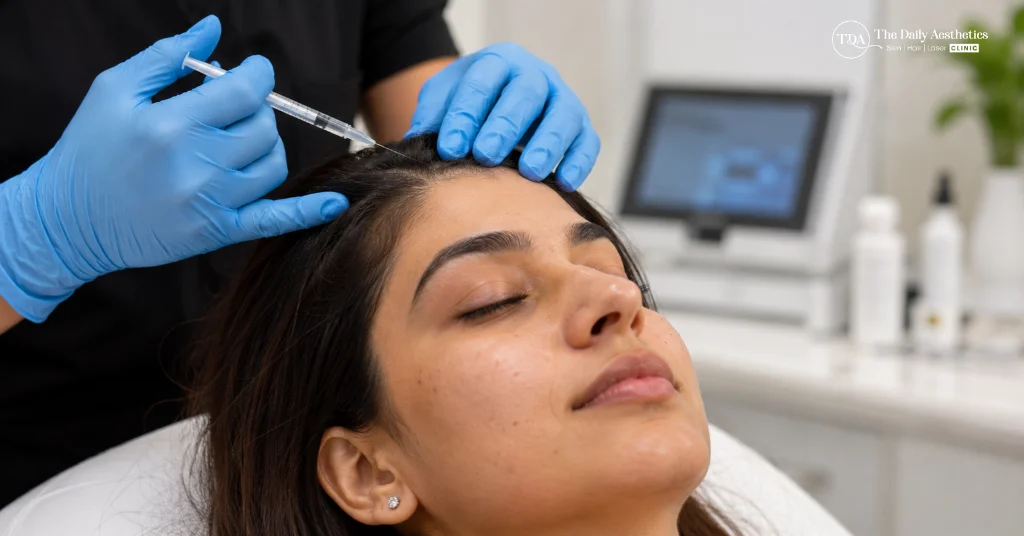
Exosome-related preparations have been studied with different delivery methods, including topical application alongside procedures and injection-based approaches. Because preparation and delivery vary, there is no single universal exosome hair protocol that every patient should expect.
The method proposed by a clinician should be explained in plain language, including whether the skin barrier is being disrupted, what material is used, how it is handled, what immediate effects can occur and what follow-up is planned. Treatment should never proceed solely on the basis of the word “exosome” on a package.
Detailed session plans can be very different across products and clinics, which is why it is unhelpful to promise one fixed number of visits. The key first step remains an assessment of the hair-loss cause and a transparent discussion of the product and delivery route.
A fuller discussion of treatment logistics is available in the exosome hair therapy guide; this article concentrates on the biological rationale and the strength of the available evidence.
When Might Hair Changes Become Visible?
Hair changes are gradual because follicles move through biological growth cycles. In small studies of exosome-based approaches, researchers have commonly measured hair counts or thickness after weeks to months. That does not establish a reliable calendar for a particular product or guarantee that an individual will see visible improvement.
A useful follow-up plan compares standardised photographs, a consistent hair-parting view, scalp examination and, where available, measured shaft or density changes. Daily selfies in different lighting can make ordinary variation look like either dramatic regrowth or failure.
- First weeks: Focus on recovery, any side effects and whether shedding has another cause; avoid treating this as proof of regrowth.
- Following months: Review objective changes in hair density, thickness and overall appearance when clinically appropriate.
- Longer term: Ask what evidence supports durability and what happens if pattern hair loss continues to progress.
- At every review: Reassess the underlying diagnosis and whether established medical care should be started or adjusted.
Promotional claims such as “visible new hair in days” or “permanent regrowth after one visit” are not supported as general expectations for exosome hair therapy.
What Are the Safety, Product-Quality and Regulatory Considerations?
Safety is a major part of the decision because human trials are limited, follow-up is often short and exosome formulations vary. Even when small studies report few problems, that does not establish long-term safety for every product or delivery route. Possible concerns include irritation, inflammation, infection, hypersensitivity and problems linked to inadequate manufacturing or handling.
In the United States, the current regulatory safety notice states that there are no FDA-approved exosome products. That is a statement about U.S. regulatory status; it should not be misrepresented as a product-specific decision by Indian authorities. Patients in Pune should ask for exact product details and appropriate local regulatory documentation rather than assuming that “advanced” or “regenerative” means approved.
A responsible discussion includes the difference between an experimental approach and an established treatment; whether the preparation is genuinely characterised as an exosome product; and how storage, sterile handling and quality assurance are verified.
- Product identity: What exactly is being used and what is its documented biological source?
- Quality controls: How are identity, purity, sterility, storage and handling verified?
- Applicable oversight: What approvals or permissions apply to this product and intended use?
- Treatment route: Is it topical, injection-based or paired with another procedure, and what risks follow from that route?
- Consent and follow-up: What benefits are uncertain, what adverse events should be reported and who manages complications?
Bottom Line: Exosomes are not the same as stem-cell injections, and promising research should not be used to bypass product verification, informed consent or diagnosis.
What Should You Ask Before Choosing Exosome Hair Therapy?
You should leave a consultation understanding why a treatment has been suggested for your exact hair-loss pattern and what evidence applies. You should not have to choose between an enthusiastic sales promise and doing nothing; a thoughtful plan can include diagnosis, conventional care, monitoring and a careful discussion of emerging options.
- What is my diagnosis? Ask whether the loss is androgenetic, temporary shedding, inflammatory or another condition.
- Are my follicles still active? Ask what the scalp examination shows and where visible density is realistically possible.
- What established options are relevant? Discuss medical treatment, scalp care, low-level laser support or surgery when appropriate.
- What is the actual exosome product? Ask for its source, preparation, storage and regulatory documentation.
- What evidence applies to me? Check whether human studies involved a similar condition, preparation and method.
- How will we judge progress? Agree on follow-up photographs, measurements and a plan if results are disappointing.
Considering Exosome Hair Therapy in Pune?
A consultation at The Daily Aesthetics Clinic can start with your thinning pattern, scalp condition and previous treatment history before discussing suitability.
Book Your ConsultationWhat Should You Know Before Choosing Exosome Hair Therapy in Pune?
For Pune patients, convenience matters because hair-loss decisions rarely end with one appointment. Follow-up visits may involve examination, photograph comparisons, changes in home care and review of whether the original diagnosis still fits.
The Daily Aesthetics Clinic offers hair-related consultations across Kalyani Nagar, Kharadi and Baner. It is sensible to choose a location where you can attend follow-up reviews consistently, especially when you are tracking gradual changes over several months.
| Clinic | Address | Phone |
| Kalyani Nagar | Plot 17, Lane No. 7, next to Hotel Sudharshan, opposite Lunkad Sky Lounge, Kalyani Nagar, Pune, Maharashtra 411006 | +91 96738 58066 |
| Kharadi | Shop No. 120, Gera Imperial, Rajaram Patil Nagar, Vittal Nagar, Kharadi, Pune, Maharashtra 411014 | +91 97685 55421 |
| Baner | Shop No. 11, A-wing, SR. No. 32, Sterling Tower, Off Pancard Club Road, Baner, Pune, Maharashtra 411045 | +91 91585 80123 |
Clinic hours and available appointments can change. Contact the preferred branch before visiting.
Why Choose The Daily Aesthetics Clinic?
Hair thinning can affect how you style your hair, feel in photographs or approach daily routines. A useful consultation should recognise that experience without turning it into pressure to buy a treatment. The priority is an explanation of what is happening and what can reasonably be done.
The Daily Aesthetics Clinic offers a range of hair and scalp options in Pune. Depending on the diagnosis, the discussion may include hair growth therapy, PRP, GFC, low-level laser approaches or transplant planning, alongside an honest explanation of the emerging evidence around exosomes.
When permanently lost follicles are a concern, hair transplant treatment may be a more relevant separate discussion than expecting exosomes to build new follicles. When active miniaturised follicles remain, treatment decisions still depend on the complete clinical picture rather than one technology label.
A well-considered plan should include expectations, limitations, safety questions and appropriate follow-up. These details matter more than promising a particular number of new hairs.
Build Your Hair Plan Around Follicle Health
Understand the likely cause of thinning and compare treatment options on suitability, evidence, safety and long-term follow-up.
Contact The Daily Aesthetics ClinicConclusion
Exosomes for hair growth are being studied because their cell-to-cell signals may influence the environment around living hair follicles. Small human studies give reasons for cautious interest, but they do not establish a guaranteed cure, a standardised treatment course or proven results for every form of hair loss.
The more useful question is not whether exosomes are the newest option. It is whether the follicles are viable, the diagnosis is clear, and the available evidence justifies considering this particular preparation. Established treatments and careful monitoring may be more important in many situations.
If you are noticing a widening part line, crown thinning or changing hair density, speak with The Daily Aesthetics Clinic about a scalp assessment and an individual plan built around realistic expectations rather than trend-driven promises.
Frequently Asked Questions
1. What Are Exosomes for Hair Growth?
Exosomes are extracellular vesicles that can carry signals between cells. Researchers are studying whether selected preparations may influence the environment around living follicles. They are not stem cells and are not a proven treatment for every kind of hair loss.
2. Do Exosomes Really Regrow Hair?
Some small human studies report improvements in density or hair thickness, but the research is not yet strong enough to predict reliable results across products and patients. The treatment remains emerging, with important questions about standardisation, long-term outcomes and safety.
3. Can Exosome Therapy Help Male and Female Pattern Hair Loss?
Androgenetic alopecia, including male and female pattern thinning, is the most studied hair-loss setting for exosome-based approaches. Viable miniaturised follicles may be relevant, but diagnosis, current medical treatment and product quality should guide any discussion.
4. Can Exosomes Regrow Hair on Completely Bald Areas?
They cannot be relied on to recreate follicles that are permanently absent or destroyed by scarring. A smooth, longstanding bald area may need a different assessment and sometimes a discussion of hair transplantation or other options.
5. How Is Exosome Hair Therapy Different From PRP?
PRP uses a platelet-rich preparation from the patient’s own blood. Exosome-based treatments involve extracellular vesicles or related materials whose source and processing vary. Neither should be chosen without considering diagnosis, evidence, risks and the actual preparation used.
6. How Long Might Exosome Hair Therapy Take to Show Visible Changes?
Human investigations generally measure hair changes over weeks to months rather than days. A specific treatment cannot promise an exact timeline. Standardised photos and scalp measurements are more useful than judging changes in daily mirror checks.
7. Are Exosome Hair Treatments Safe?
Long-term safety is not fully established, and product quality and delivery methods differ. Any proposed treatment should be discussed with a qualified clinician, including potential reactions, infection risk, regulatory status, product sourcing and complication follow-up.
8. Who Is a Suitable Candidate for Exosome Hair Therapy?
A person with confirmed hair-loss diagnosis and viable follicles may be considered for a careful evidence-led discussion. Sudden unexplained shedding, inflamed scalp disease, scarring hair loss or permanently bald areas require appropriate diagnosis and may call for other treatments first.