


Introduction
When most people hear the words “exosome therapy,” they picture something out of a laboratory science fiction film.
In reality, exosomes are tiny messenger particles your own cells already use every day to talk to each other, coordinate repair, and keep skin functioning as it did in your twenties. Aesthetic medicine has learned to bottle that conversation.
If you have been researching regenerative treatments for fine lines, dull skin, acne scars, or loss of firmness, you have almost certainly seen exosomes mentioned alongside PRP, polynucleotides, and skin boosters.
What is genuinely new here is not a stronger version of collagen cream; it is a way of sending your cells a direct instruction to rebuild.
At The Daily Aesthetics Clinic in Pune, our advanced exosome therapy protocols are physician-led, combined with medical-grade delivery devices, and tailored to how Indian skin actually responds to regenerative treatments.
Every plan is built around your Fitzpatrick skin type, your goal, and the concern you actually want addressed, whether that is post-acne texture, early aging, or a full glass-skin reset.
This guide walks you through what exosome therapy for skin really is, how it works at a cellular level, what it can and cannot treat, and what a session in Pune costs.
Plus, we also cover how it compares to PRP and PDRN, and what you need to know about safety and regulatory status before you book.
Key Takeaways
- Exosomes are nano-sized messenger vesicles (30 to 150 nm) that carry growth factors, proteins, and RNA between cells, and they are now being used in dermatology to signal collagen and elastin production, calm inflammation, and speed up skin repair.
- Exosome therapy is best for early aging, post-acne texture, dull or dehydrated skin, mild sagging, and combination protocols with microneedling, RF, or laser.
- On Indian skin, exosomes offer a lower risk of post-inflammatory hyperpigmentation compared with aggressive resurfacing, because the treatment works through cellular signaling rather than heat or peeling.
- A typical face plan is 3 to 6 sessions spaced 3 to 4 weeks apart, with visible glow in days and firmer, smoother skin developing over 3 to 6 months.
- In Pune, exosome therapy sessions typically range from ₹15,000 to ₹40,000 per session, depending on the source, protocol, and delivery device.
- No exosome product is currently FDA-approved for aesthetic use. Patients should always be treated by a qualified aesthetic physician using clearly sourced products and validated delivery devices.
- Exosome therapy is not a wrinkle filler or a facelift. It rebuilds skin quality from within, and works best alongside good sun protection, active skincare, and realistic timelines.
What Is Exosome Therapy for Skin?
Exosomes are nano-sized vesicles, roughly 30 to 150 nm in diameter, released by nearly every cell type in the human body.
They ferry proteins, lipids, messenger RNA, and microRNA between cells and act as a coordination layer for tissue repair, immune signaling, and, of relevance to dermatology, collagen production and pigment regulation.
A 2025 narrative review in the peer-reviewed dermatology literature describes exosomes as one of the most active frontiers in regenerative skin science, with clinical interest concentrated on wounds, scars, photoaging, and inflammatory dermatoses.
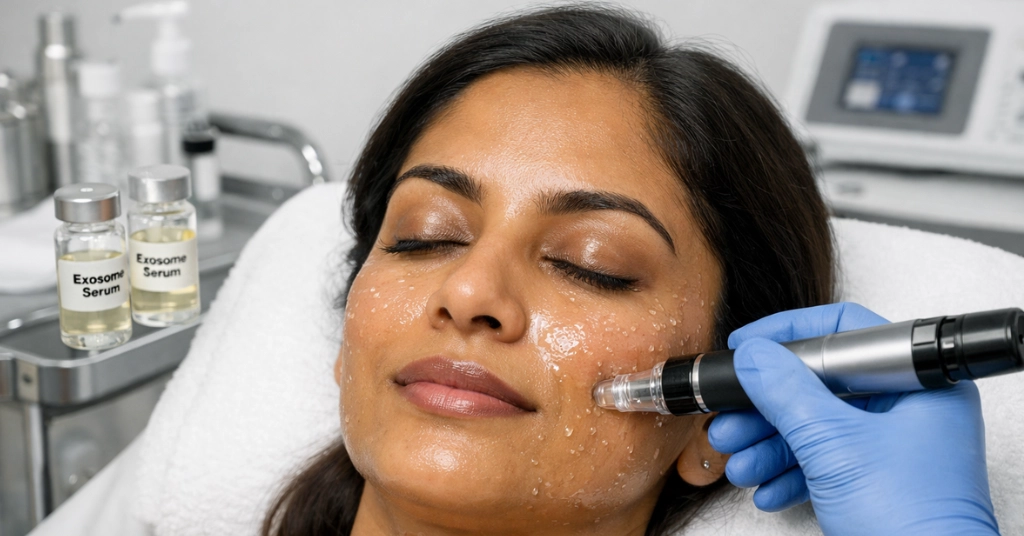
In aesthetic practice, exosomes are typically sourced from lab-cultured stem cells (commonly mesenchymal stem cells or Wharton’s jelly-derived cells), purified into a serum, and delivered via microneedling, targeted injection, or radiofrequency channels.
They contain no live cells or DNA, so they do not replicate.
They act as pure signals: aged cells behave lazily, and exosomes hand them a fresh set of instructions.
How Exosome Therapy Rejuvenates the Skin
Three effects matter for the results you actually see in the mirror.
1. Collagen and elastin stimulation. Exosomes carry growth factors and RNA cargo that signal fibroblasts, the cells that build your skin’s structural framework, to ramp production of Type I and Type III collagen and elastin. Over weeks, this shows up as firmer skin, tighter pores, and smoother texture.
2. Inflammation control. Exosomes have well-documented anti-inflammatory activity, which is why they are often used to speed up recovery after CO2 laser, microneedling, or aggressive peels. Less inflammation on Indian skin usually means less post-inflammatory pigmentation risk.
3. Cellular energy and turnover. By delivering functional proteins to older skin cells, exosomes support healthier keratinocyte turnover, better barrier function, and a more even tone, which is what most patients describe as the “glow” outcome.
A clinical study on topical Wharton’s jelly MSC-derived exosome treatments after microneedling, published in the Journal of Cosmetic Dermatology, reported measurable improvements in skin hydration, elasticity, and appearance across the study period, supporting the mechanism at the visible skin level.
What Exosome Therapy Actually Treats
The strongest use cases in aesthetic practice today:
- Early signs of aging: fine lines, loss of firmness, dullness
- Post-acne skin: shallow acne scars, uneven texture, pockmarks
- Photoaging: sun damage, uneven skin tone, roughness on décolletage and hands
- Under-eye concerns: thin skin, dark shadowing, crepiness
- Dehydrated or sensitive skin: compromised barrier, redness, tightness
- Post-procedure recovery: faster healing and less downtime after ablative laser, RF microneedling, or aggressive peels
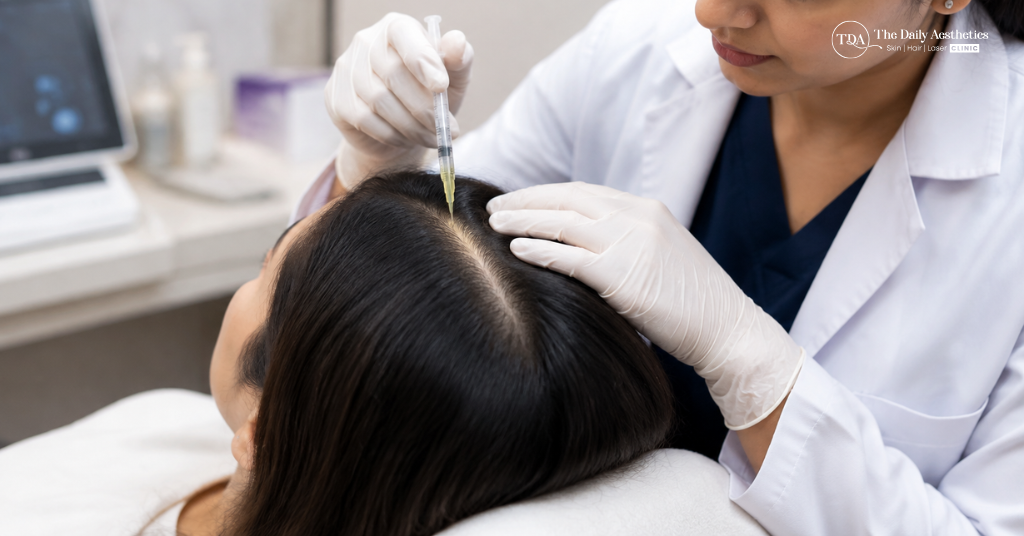
- Adjunct in hair loss protocols: as part of a multi-modal plan with PRP, PDRN, or in-clinic scalp treatments
Exosomes are not a substitute for volume restoration (that is filler territory), muscle relaxation (that is Botox), or deep structural lifting (that is HIFU, threads, or surgery). They are a skin-quality treatment.
Exosome Treatment Protocols Used in Aesthetic Practice
Most Pune clinics that offer exosomes will use one or more of the following delivery routes.
At The Daily Aesthetics, Dr. Arshi Rahul selects the protocol based on your concern, skin type, and pain tolerance, rather than a one-size-fits-all menu.
| Protocol | Best For | Typical Session Time |
| Exosome + Microneedling Infusion | Early aging, dullness, texture, mild acne scars | 60 to 75 minutes |
| Exosome + RF Microneedling | Deeper acne scars, laxity, larger pores | 75 to 90 minutes |
| Targeted Exosome Injection | Under-eye thinning, focal scars, localized dark spots | 30 to 45 minutes |
| Exosome + Hyaluronic Booster | Dehydration, barrier repair, sensitive or mature skin | 45 to 60 minutes |
| Post-Laser Exosome Recovery | Reducing downtime and PIH risk after CO2 or fractional laser | 20 to 30 minutes add-on |
| Exosome Mesotherapy (superficial) | Overall glow, tone evenness, prep before events | 45 minutes |
The protocol you get should be a clinical decision, not an upsell. Always ask which delivery route is being used and why.
Exosomes vs. PRP vs. PDRN: How to Choose
This is the single most common question patients ask, because all three treatments sit in the “regenerative” bucket and get pitched interchangeably. They are not the same.
| Feature | PRP (Vampire Facial) | Exosome Therapy | PDRN / Salmon DNA |
| Source | Your own blood, spun in a centrifuge | Lab-purified vesicles from cultured stem cells | Purified DNA fragments from salmon sperm |
| Growth factor content | ~20 to 30 natural growth factors | Hundreds of standardized signaling molecules | Nucleotide precursors, not growth factors |
| Consistency batch to batch | Depends on your age, health, and blood quality | Standardized, high potency | Standardized |
| Preparation | Requires blood draw and centrifuge | Ready-to-use serum vial | Ready-to-use injectable |
| Primary aesthetic use | Skin quality, mild texture, hair loss | Skin regeneration, scars, post-procedure repair, glow | Deep hydration, elasticity, under-eye rejuvenation |
| Ideal for | Patients wanting an autologous option | Patients wanting maximum signaling potency | Patients wanting hydration and structural elasticity |
| Downtime | 24 to 48 hours redness | 12 to 24 hours mild redness | Minimal, mostly injection marks |
In practice, many Pune plans layer these treatments. PDRN or PRP for the base rebuild, exosomes as the finisher, and a course of chemical peels or laser sitting alongside.
If you want a deeper read on the specific role of nucleotide-based regeneration, our guide to PDRN therapy covers the science in more depth.
Sessions, Downtime, and Results Timeline
A realistic plan for most face concerns looks like this:
- Course length: 3 to 6 sessions
- Spacing: every 3 to 4 weeks
- Session duration: 45 to 90 minutes including numbing
- Downtime: 12 to 24 hours of mild redness or pinpoint bleeding after microneedling infusion; minimal after superficial mesotherapy
- When you notice a glow: 3 to 7 days
- When firmness and texture improvement peaks: 3 to 6 months
- How long results last: 6 to 12 months, longer with maintenance
Deeper concerns like pitted acne scars sit at the top of that range. Maintenance sessions every 6 to 12 months keep collagen output high. Daily sunscreen and an active skincare routine, ideally with a well-tolerated retinoid, extend results significantly.
Our retinol for beginners guide is a good starting point.
Is Exosome Therapy Safe for Indian Skin?
This is the right question to ask, and the honest answer has three parts.
- Part one: mechanism-level safety on skin of color is good: Because exosomes rely on cellular signaling rather than heat, ablation, or aggressive peeling, they carry a lower theoretical risk of post-inflammatory hyperpigmentation than energy-based devices used alone.
A 2025 review in Cureus focused on exosomes in skin of color and the Indian clinical context notes that exosomes participate in melanocyte function and pigment pathways, and that early data suggest a favorable safety signal for higher Fitzpatrick skin types, while also cautioning that population-specific trials are still limited.
- Part two: the source and the operator matter far more than the marketing: The most common safety issues with exosome therapy globally have been contamination, misbranding, and non-standardized products, not the biology itself. Choose a clinic that can tell you exactly where the exosomes are sourced, how they are stored, and who is delivering the treatment.
- Part three: expectations should be Fitzpatrick-appropriate: For Fitzpatrick IV to VI, protocols are usually gentler on depth and heat, favor lower-intensity microneedling, and lean more on cellular signaling than trauma. Dr. Arshi Rahul routinely adjusts device settings and combines exosomes with barrier-supporting boosters to keep the risk of pigmentation flare-ups minimal on Indian skin.
What Exosome Therapy Costs in Pune
Pricing varies more than most treatments because the exosome market is unregulated on the product side, and clinics use vastly different sources. A realistic Pune range as of 2026:
| Protocol | Typical Cost per Session |
| Superficial exosome mesotherapy | ₹15,000 to ₹25,000 |
| Exosome + microneedling (full face) | ₹20,000 to ₹35,000 |
| Exosome + RF microneedling | ₹30,000 to ₹50,000 |
| Targeted under-eye exosome | ₹15,000 to ₹25,000 |
| Post-laser exosome recovery add-on | ₹5,000 to ₹10,000 |
A full course of 3 to 6 sessions typically works out to ₹60,000 to ₹2,00,000. Package pricing at a full-service clinic almost always beats à la carte per-session pricing.
Ask about: source of exosomes (Wharton’s jelly, adipose-derived, plant-based), concentration per vial, delivery device (basic derma pen vs medical-grade microneedling or RF), who performs the treatment (physician vs therapist), and whether numbing, post-care serum, and follow-up are included in the price.
The Regulatory Reality: What You Should Actually Ask Your Clinic
Because this is a rapidly growing category, it is worth being straight about the regulatory picture.
The US FDA’s Public Safety Notification on Exosome Products states clearly that no exosome product is currently FDA-approved.
In India, exosome products for cosmetic use similarly sit ahead of formal approval frameworks. Clinical trials are ongoing, and the efficacy science is genuinely promising, but the products themselves are not yet regulator-approved drugs.
That does not automatically make exosome therapy unsafe, and it does not erase published clinical evidence.
It does mean the product source, provider qualifications, and delivery device carry more weight than in a fully standardized category.
Fair questions to ask any clinic:
- What is the source of the exosome product you use?
- Is the delivery device (microneedling pen, RF platform, laser) US FDA-cleared for its own indication?
- Who administers the treatment, physician or technician?
- What is your protocol for sensitive or highly pigmented skin?
At The Daily Aesthetics, every exosome session is planned and supervised by a qualified aesthetic physician, uses medical-grade delivery devices, and is documented in your clinical record so you always know exactly what was used.
Who Is a Good Candidate (and Who Is Not)
- Good candidates typically include adults with early to moderate photoaging, post-acne texture, dullness, dehydration, mild sagging, or those recovering from ablative laser or aggressive peels. Men and women in their 30s to 50s who want to slow the trajectory of visible aging tend to do very well with a structured course.
- Not the right fit right now: anyone actively pregnant or breastfeeding, patients with active skin infections at the treatment site, those with known bleeding disorders without medical clearance, or anyone expecting a filler or surgical-level lift from a signaling treatment.
If your primary concern is volume loss or deep folds, our dermal fillers guide is a better starting point.
Pre and Post Care to Make Results Actually Last
- Before your session: avoid direct sun for a week, pause retinoids and acids for 3 days, hold blood thinners like aspirin for 3 days (only if medically safe), and hydrate well.
- After your session: wait 12 hours before washing your face, skip saunas and heavy workouts for 48 hours, wear broad-spectrum SPF 50 daily, and stick to a gentle cleanser and moisturizer for the first 3 days. Reintroduce actives only when your clinician clears you.
Results compound with a consistent skincare routine and sun protection. Skipping either is the fastest way to waste an expensive course.
Conclusion
Exosome therapy is one of the most exciting advances in regenerative dermatology, and for the right person, it delivers on the promise of firmer, smoother, more even skin without surgery.
It is not magic, it is signaling, and how well it works depends on choosing the right protocol, the right clinician, and pairing it with sensible daily skincare.
If you are in Pune and thinking about starting an exosome course for early aging, acne scars, dull skin, or as part of a broader anti-aging plan, the shortest path to a straight answer is a consultation with a qualified aesthetic physician who can look at your skin, discuss your goals, and tell you honestly whether exosomes, PRP, PDRN, or a combination is the best fit.
Dr. Arshi Rahul and the team at The Daily Aesthetics run daily exosome consultations across our Kharadi, Baner, and Kalyani Nagar clinics.
Every plan is tailored to Indian skin, built around your Fitzpatrick type, and delivered by a physician, not a template.
Frequently Asked Questions
1. How is exosome therapy different from PRP?
PRP uses your own blood-derived platelets and natural growth factors. Exosomes are standardized, lab-purified signaling vesicles from stem cells, delivering a broader and more consistent set of instructions. Exosomes are usually more potent per session; PRP has the advantage of being autologous.
2. Can exosome therapy be combined with laser or microneedling?
Yes, and this is one of its strongest use cases. Combining exosomes with fractional laser or microneedling improves results and shortens downtime, because the anti-inflammatory action of exosomes helps the skin recover faster.
3. Is exosome therapy safe on darker Indian skin tones?
Because it relies on cellular signaling rather than heat or aggressive peeling, it carries a lower theoretical risk of post-inflammatory hyperpigmentation than energy-based treatments used alone. Protocols should still be adjusted for Fitzpatrick IV to VI skin.
4. How many sessions will I actually need?
Most patients see best results with 3 to 6 sessions spaced 3 to 4 weeks apart. Deeper acne scars or advanced photoaging sit at the higher end of that range.
5. Is exosome therapy FDA-approved for aesthetic use?
No exosome product is currently FDA-approved for cosmetic indications anywhere in the world. Clinical trials are ongoing, and the treatment is offered legally by physicians in many countries including India. The FDA-cleared piece in a well-run clinic is usually the delivery device, not the exosome product itself.
6. Will exosome therapy replace my Botox and fillers?
No. Exosomes rebuild skin quality. Botox relaxes muscle-driven wrinkles. Fillers restore lost volume. They work well together but do not substitute for each other.
7. How soon before an event should I do exosome therapy?
Book your last session at least 2 weeks before an event so redness settles and the initial glow peaks. For firmness and texture, start your course 3 to 4 months out.
The Daily Aesthetics Clinic – Redefining Skin & Hair Treatments in Pune
The Daily Aesthetics Clinic is a trusted dermatology and aesthetic center in Pune, offering advanced treatments for acne, pigmentation, hair loss, laser hair removal, Hydrafacials, hair transplants, and personalized skincare.
Under the guidance of Dr. Arshi Rahul, the clinic combines medical expertise with FDA-approved technology to deliver customized treatment plans that focus on restoring skin health, enhancing radiance, and ensuring every patient feels confident and cared for.
With the trust of over 3,500 patients and a 4.9★ rating, The Daily Aesthetics Clinic is known for delivering effective, safe, and personalized care in a calm, welcoming setting.
We serve clients across Pune through our three conveniently located clinics in Baner, Kharadi, and Kalyani Nagar.
Read More:
- What Are Exosomes and How They Help Skin Repair Naturally
- Hydrafacial Price in Pune – What You Get for Your Money at The Daily Aesthetics Clinic
- Understanding Hydrafacial Treatment: Complete Guide to Process, Benefits, and Costs