

Introduction
Most people walk into a skin clinic asking for the treatment they saw a celebrity get on Instagram.
The honest answer is usually a different treatment entirely, or a smaller version of the same one, or sometimes just better sunscreen and a month of consistent use.
Skin rejuvenation is not one product. It covers hydra-dermabrasion, chemical exfoliation, cold therapy, lasers, and microneedling.
Each works on a different layer of the skin, targets a different concern, and costs a different amount of time, money, and downtime.
At The Daily Aesthetics, we run three clinics across Pune, in Kharadi, Baner, and Kalyani Nagar, and the first thing we do in every consultation is match the treatment to the concern.
Dr. Arshi Rahul and the team see roughly the same three questions on repeat: what does a HydraFacial actually do, do chemical peels really work for pigmentation, and is a cryofacial worth the hype. See our HydraFacial protocol here.
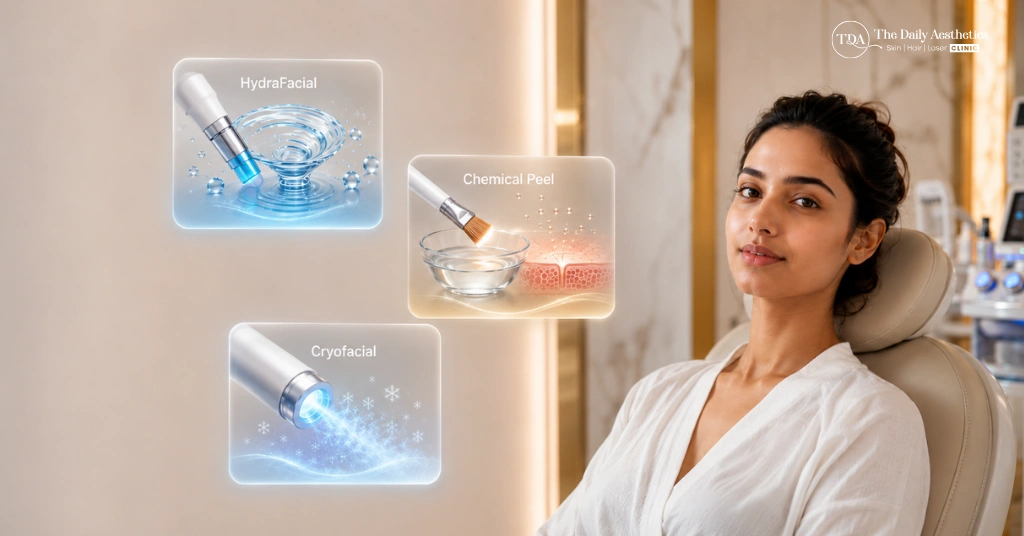
This guide breaks down HydraFacial, chemical peel, and cryofacial side by side.
You’ll know what each treatment does at a biological level, who it’s best suited to, what it costs in Pune, how long you’ll be red or peeling, and how to decide which one your skin needs right now.
Key Takeaways
- HydraFacial is a hydra-dermabrasion device that cleanses, exfoliates, extracts, and infuses serums in one 30 to 45 minute session. It suits dull skin, congested pores, mild acne, and anyone who wants zero downtime.
- Chemical peels use acid solutions like glycolic, salicylic, mandelic, or TCA to controlled-exfoliate the skin. They are the strongest option here for pigmentation, melasma, acne scarring, and photoaging, but require the most downtime.
- Cryofacial uses vaporized liquid nitrogen at extremely low temperatures for 2 to 3 minutes on the face. It gives short-term tightening, reduces puffiness, and boosts circulation, but has the least clinical evidence of the three.
- HydraFacial has been clinically shown to improve acne severity in 100% of participants in a peer-reviewed 12-week study, making it the most data-backed of the three for active mild to moderate acne.
- Chemical peels are safe and effective across Fitzpatrick skin types I to VI when the acid, strength, and priming protocol match the skin type. Deeper peels carry higher post-inflammatory hyperpigmentation risk in Fitzpatrick IV to VI.
- Combining treatments (peel plus HydraFacial spaced out, cryofacial as a finishing step) often gives better results than repeating any single one, but the sequencing matters and must be dermatologist-led.
- The FDA has warned consumers not to use chemical peel products at home without professional supervision. Every treatment in this guide is safest, and works best, when a qualified aesthetic physician plans it.
What “Skin Rejuvenation” Actually Means
Skin rejuvenation is the umbrella term for any treatment that improves how your skin looks and functions, without surgery.
That includes reducing pigmentation, softening fine lines, clearing congestion, boosting hydration, tightening pores, and evening out tone.
The global non-invasive aesthetic treatment market was valued at USD 82.73 billion in 2024 and is forecast by Straits Research to reach USD 299.09 billion by 2033. Facial procedures sit at the center of that growth.
Where the three treatments differ is in mechanism. HydraFacial exfoliates and infuses.
Chemical peels chemically ablate. Cryofacials cool and constrict. Different tools, different jobs.
HydraFacial: What It Is and Who It’s For
HydraFacial is a hydra-dermabrasion treatment.
That means it combines mechanical exfoliation (through vortex suction) with topical solutions that cleanse, extract debris from pores, and infuse serums like hyaluronic acid, peptides, and antioxidants into the skin.
A standard session takes 30 to 45 minutes. There is no numbing, no needles, no peeling afterwards, and no downtime. Most patients go straight back to work, sometimes with makeup on.
What the clinical evidence says
The most robust study on HydraFacial is a 2022 peer-reviewed trial published in The Journal of Clinical and Aesthetic Dermatology.
Twenty adults with mild to moderate active acne received six clarifying HydraFacial sessions over 12 weeks. All participants reported improvement in acne severity, and confidence scores rose from 40% after the first session to 100% by the final one.
That’s a small sample, but it’s the first prospective clinical study of its kind on this device, and the results held across varied skin tones.
Who HydraFacial is best for
- Dull, tired, or dehydrated skin that needs a fast reset before an event
- Congested skin with blackheads, whiteheads, and enlarged pores
- Mild to moderate active acne, especially in patients who can’t tolerate stronger topicals
- Sensitive skin that reacts to acids or lasers
- Anyone who wants results with zero downtime
Who it isn’t for
HydraFacial won’t reverse deep acne scarring, dense melasma, deep wrinkles, or advanced photoaging. For those, you need a peel, a laser, or microneedling, not a facial.
Chemical Peel: What It Is and Who It’s For
Chemical peels use acid solutions to controlled-exfoliate the skin.
The acid dissolves the bonds between dead skin cells, letting them shed and revealing fresher skin underneath.
The deeper the peel penetrates, the more dramatic the result and the longer the recovery.
Per the NCBI StatPearls chapter on chemical peels, peels are classified by depth: very light and light peels (10 to 30% TCA, low-strength AHAs, Jessner’s solution), medium peels (35% TCA with Jessner’s or 70% glycolic acid), and deep peels (TCA above 50%, or phenol-croton oil combinations).
The main acids and what they treat
- Glycolic acid (AHA): smooths texture, brightens tone, softens fine lines. Best on non-oily, sun-damaged skin.
- Salicylic acid (BHA): oil-soluble, penetrates pores, ideal for acne and oily skin. Considered a gold standard superficial peel for active acne.
- Mandelic acid: gentler AHA, better tolerated on darker skin tones and sensitive skin.
- Trichloroacetic acid (TCA): medium to deep peel, treats pigmentation, sun damage, mild acne scars, and photoaging.
- Jessner’s solution: salicylic acid plus lactic acid plus resorcinol. Used for acne and hyperkeratotic lesions.
The Fitzpatrick scale question
If you have Fitzpatrick skin type IV, V, or VI (medium brown to deeply pigmented), which covers a large share of Indian patients, deeper peels carry a higher risk of post-inflammatory hyperpigmentation.
A 2018 review in Clinical, Cosmetic and Investigational Dermatology recommends avoiding deep peels in Fitzpatrick IV to VI and emphasizing pre-peel priming with agents like hydroquinone or retinoids.
That doesn’t mean peels don’t work on brown skin. They do. The choice just shifts to superficial peels done in a series, done under proper dermatologist supervision, with pre-priming.
At The Daily Aesthetics, our clinical chemical peel protocol maps the acid and strength to your Fitzpatrick type first, before we discuss the concern.
That single decision determines whether you get a lasting result or a pigmentation flare.
Who chemical peels are best for
- Pigmentation, melasma, sun damage, and uneven tone
- Post-inflammatory hyperpigmentation from acne
- Fine lines and early photoaging
- Textural roughness and enlarged pores
- Acne (salicylic acid peels specifically)
Safety notes
The FDA has publicly warned against at-home chemical peels, citing serious chemical burns, discoloration, and scarring from unsupervised use of TCA, glycolic, salicylic, and lactic acid at concentrations too high for home application.
The American Academy of Dermatology’s official chemical peel guidance echoes this: peels belong in the hands of a licensed, trained provider.
Cryofacial: What It Is and Who It’s For
A cryofacial (sometimes marketed as “frotox”) uses vaporized liquid nitrogen delivered from a handheld wand, cooling the face for 2 to 3 minutes.
The cold constricts blood vessels, then triggers a rebound flush of oxygen-rich blood when the skin returns to normal temperature.
The mechanism is well-documented in cold therapy generally. Cryotherapy has been used in dermatology since the 1800s for treating warts, actinic keratoses, and skin tumours, per the NCBI StatPearls chapter on cryotherapy in dermatology.
The cosmetic cryofacial version uses much shorter exposure times and controlled vapour rather than direct liquid nitrogen contact, so tissue destruction isn’t the goal.
What a cryofacial does
- Short-term tightening from vasoconstriction and rebound circulation
- Reduces puffiness, especially around the eyes and jawline
- Increases blood flow, which can make products applied afterwards absorb better
- Gives an immediate cool-toned glow
What it doesn’t do
There is limited peer-reviewed clinical data specific to the cosmetic cryofacial (as opposed to medical cryotherapy for lesions).
Claims about collagen production, wrinkle reversal, and deep skin rejuvenation are largely mechanism-based rather than trial-backed. Results are also short-lived, typically 24 to 72 hours.
Who cryofacial suits
- Someone wanting a fast pick-me-up before an event, dinner, or shoot
- Puffy skin, tired eyes, morning-after face
- Skin that reacts to acids and can’t tolerate a peel
- A finishing step layered on top of a HydraFacial or after peel healing
Who it doesn’t suit
If your goal is durable improvement in pigmentation, texture, or acne scarring, a cryofacial alone will disappoint. Use it for what it does well, not as a replacement for treatments that reach deeper into the skin.
HydraFacial vs Chemical Peel vs Cryofacial: Side-by-Side Comparison
| Factor | HydraFacial | Chemical Peel | Cryofacial |
| Mechanism | Vortex hydra-dermabrasion plus serum infusion | Acid-based controlled exfoliation | Vaporized liquid nitrogen (cold vasoconstriction) |
| Session time | 30 to 45 minutes | 20 to 60 minutes | 10 to 15 minutes |
| Downtime | None | 1 day (light) to 14 days or longer (deep) | None |
| Discomfort | None, described as relaxing | Mild tingling to significant burning | Cold and intense but brief |
| Best for | Dullness, congestion, mild acne, event prep | Pigmentation, melasma, texture, acne, photoaging | Puffiness, tightening, event prep |
| Downside | Won’t fix deep concerns | Peeling, redness, PIH risk in darker skin | Short-lived, thin clinical evidence |
| Sessions to see change | Immediate glow; 4 to 6 for lasting change | 3 to 5 light peels or 2 to 3 medium peels | Immediate; results don’t accumulate much |
| Fitzpatrick safety | Safe across all types | Safe with correct acid and priming | Safe across all types |
| Typical Pune cost per session | ₹5,000 to ₹15,000 | ₹3,000 to ₹10,000 (varies with depth) | ₹2,000 to ₹5,000 |
Note: prices are indicative ranges from the wider Pune market; The Daily Aesthetics quotes are personalized in consultation.
How to Choose Based on Your Skin Type and Goal
Match the treatment to the primary concern first, skin type second.
For dullness or an event next week
Start with a HydraFacial. Instant glow, no downtime, safe across all skin types, and the least risk of a bad outcome before something important.
For pigmentation, melasma, or uneven tone
Go with a chemical peel, but insist on a dermatologist-planned series. For Fitzpatrick IV, V, or VI, that usually means a superficial mandelic or lactic peel, spaced 2 to 4 weeks apart, with pre-peel priming. Skip anything marketed as a one-shot solution.
For active acne or clogged pores
Either a salicylic acid superficial peel or a series of HydraFacials will work. HydraFacial evidence for acne is now peer-reviewed; salicylic peels are the older, more studied option.
For fine lines, texture, or acne scarring
Chemical peels do more than the other two, but alone often aren’t enough. You’ll probably need a peel plus microneedling, or a peel plus fractional laser, over several months.
For puffiness or a rushed refresh
A cryofacial works as a standalone, but you’ll get more mileage layered on top of a HydraFacial.
Combining Treatments: When Layering Works
A common question: can these treatments be combined? Yes, with structure.
- HydraFacial plus a booster serum is standard and safe. Most protocols already include this.
- Chemical peel then HydraFacial with 2 to 4 weeks between them works well for pigmentation patients who also want a hydration finish before an event.
- Cryofacial on top of HydraFacial in one visit is fine, since neither disturbs the skin barrier significantly.
- Chemical peel plus cryofacial in the same visit is not recommended. The peel already stresses the skin; adding vasoconstriction and rebound flush can worsen redness or delay healing.
Sequencing is the part patients underestimate. Your dermatologist should build the treatment calendar around your skin’s healing cycles, not the other way round. That’s the difference between compounding results and compounding side effects.
Safety, Downtime, and Realistic Expectations
Every treatment on this list has been used safely for years by dermatologists, and every one has caused avoidable harm in unsupervised settings.
- HydraFacial side effects are minimal: mild transient redness, occasionally a small breakout in the days after as pores clear. It has no downtime, but that also means overusing it (every week for months) offers diminishing returns.
- Chemical peels cause peeling, that’s the point, and can produce temporary hyperpigmentation, especially in Fitzpatrick IV to VI without pre-priming and diligent sunscreen. The FDA warning cited earlier makes clear that unsupervised at-home use can cause chemical burns and scarring.
- Cryofacials are generally low risk. Rare complications include frostbite, numbness, or blistering if the wand is held too close or too long. Anyone pregnant, nursing, or with cold urticaria or Raynaud’s should skip cryofacials.
For every treatment, the two non-negotiables afterwards are broad-spectrum SPF 30 or higher, applied daily, and gentle non-comedogenic moisturizing. A ₹50 skimping on sunscreen can undo ₹15,000 of treatment.
Cost in Pune: What You’ll Actually Pay
Ranges vary widely depending on the clinic, the exact device or acid used, and the treating physician’s experience.
- HydraFacial: ₹5,000 to ₹15,000 per session in Pune. Packages of 3 to 6 sessions typically discount 10 to 20%.
- Chemical peel: ₹3,000 to ₹5,000 for light peels, ₹5,000 to ₹8,000 for medium, ₹10,000+ for advanced or combination peels. Series of 4 to 6 sessions are standard.
- Cryofacial: ₹2,000 to ₹5,000 per session. Add-on to a HydraFacial usually costs less than a standalone.
Cost shouldn’t be the only filter. A cheap peel done by an untrained hand can leave scarring that costs ten times more to fix.
Conclusion
There is no single best skin rejuvenation treatment.
There is only the best treatment for your skin, your concern, your Fitzpatrick type, your downtime tolerance, and your goal for the next 3 to 6 months. HydraFacial is the safest instant-glow choice.
Chemical peels are the strongest tool for pigmentation and texture. Cryofacial is a fine refresh but rarely a foundation.
Getting the choice right saves you time, money, and skin. Getting it wrong wastes all three.
The Daily Aesthetics runs a HydraFacial protocol, a full chemical peel menu, and cold-therapy add-ons across three Pune clinics in Kharadi, Baner, and Kalyani Nagar, all led by Dr. Arshi Rahul and a team of aesthetic physicians. Every treatment plan starts with a consultation, not a menu.
If you’re still weighing the three, a 30-minute consultation is usually enough to settle the question. Bring photos of your concerns, a list of the products you’re currently using, and any past treatments, and you’ll walk out with a plan mapped to your actual skin, not a template.
Frequently Asked Questions
1. Can I do a HydraFacial and a chemical peel in the same week?
Not usually. HydraFacial’s mild acid step already exfoliates the skin, and stacking a peel too close can trigger irritation or over-exfoliation. Most dermatologists space them at least 2 to 4 weeks apart. Your treatment plan should sequence them based on your skin’s response, not a fixed calendar.
2. Is a cryofacial worth it, or is it just a trend?
It’s real, in that it does produce short-term tightening and reduced puffiness via vasoconstriction. It’s not a substitute for treatments that reach deeper into the skin. Use it for events, add-ons, or refresh sessions, not as a fix for pigmentation, scarring, or wrinkles.
3. Which treatment is safest for dark or brown skin (Fitzpatrick IV to VI)?
HydraFacial and cryofacial are safe across all Fitzpatrick types. Chemical peels are safe too, but the acid choice matters: mandelic, lactic, and low-strength salicylic are usually the first choices for medium-to-deep brown skin, with pre-peel priming and strict sunscreen use. Deeper peels carry higher post-inflammatory hyperpigmentation risk on darker skin.
4. How soon will I see results?
HydraFacial shows immediate glow and hydration. Chemical peels show early tone improvement in a few days, with pigmentation typically improving over 4 to 6 sessions. Cryofacial gives instant tightening that lasts 24 to 72 hours.
5. Can I do these treatments if I’m on retinol or acne medication?
Depends on the product and how recently you used it. Retinols should typically be stopped 3 to 7 days before a peel and resumed after re-epithelialization. Oral isotretinoin usually requires a longer washout period. Always disclose all medications and skincare in your consultation.
6. How much do these cost overall?
Costs vary by the depth of intervention and the number of sessions needed. A single HydraFacial in Pune usually runs ₹5,000 to ₹15,000, chemical peels ₹3,000 to ₹10,000 depending on depth, and cryofacials ₹2,000 to ₹5,000. A dermatologist will build a plan based on your goals and give a total after consultation.
7. Are there any conditions that rule out these treatments?
Yes. Active skin infections, open wounds, severe rosacea flares, and certain medications are contraindications for peels. Cryofacials are best avoided in pregnancy, breastfeeding, cold urticaria, and Raynaud’s phenomenon. HydraFacial has the fewest contraindications but is still not advised on broken or infected skin. Full disclosure at consultation is essential.
The Daily Aesthetics Clinic – Redefining Skin & Hair Treatments in Pune
The Daily Aesthetics Clinic is a trusted dermatology and aesthetic center in Pune, offering advanced treatments for acne, pigmentation, hair loss, laser hair removal, Hydrafacials, hair transplants, and personalized skincare.
Under the guidance of Dr. Arshi Rahul, the clinic combines medical expertise with FDA-approved technology to deliver customized treatment plans that focus on restoring skin health, enhancing radiance, and ensuring every patient feels confident and cared for.
With the trust of over 3,500 patients and a 4.9★ rating, The Daily Aesthetics Clinic is known for delivering effective, safe, and personalized care in a calm, welcoming setting.
We serve clients across Pune through our three conveniently located clinics in Baner, Kharadi, and Kalyani Nagar.
Read More:
- What Are Exosomes and How They Help Skin Repair Naturally
- Hydrafacial Price in Pune – What You Get for Your Money at The Daily Aesthetics Clinic
- Understanding Hydrafacial Treatment: Complete Guide to Process, Benefits, and Costs