

TDA

Skin Boosters

What Are Skin Boosters? Benefits for Hydration, Texture, Elasticity and Skin Quality

What Are Skin Boosters? Benefits for Hydration, Texture, Elasticity and Skin Quality

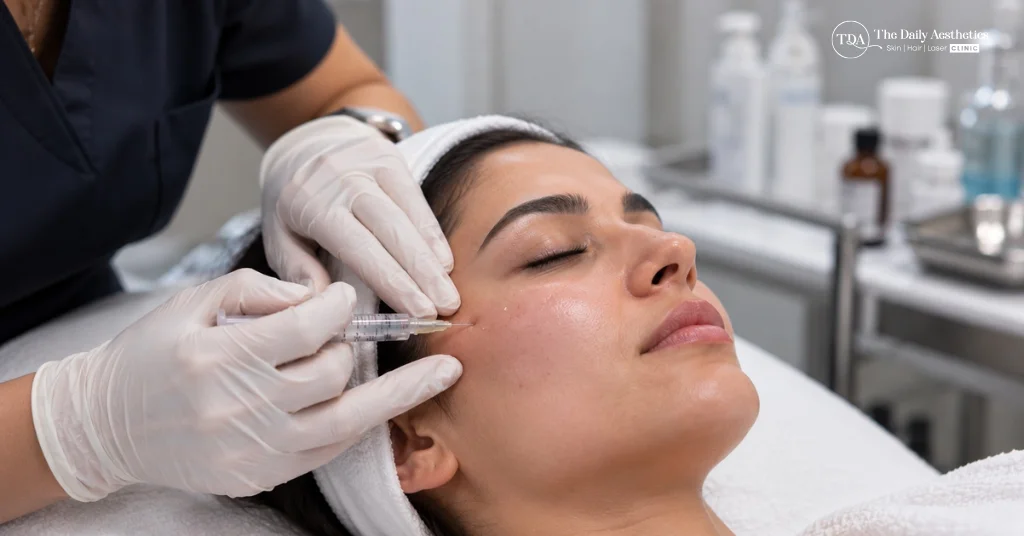
Introduction  Your skin can look tired even when you are not. It can feel tight after moisturiser, look dull under makeup, show fine dehydration lines, or lose that fresh bounce you remember from earlier years.  That is where skin boosters often enter the conversation. They are not the same as facial fillers, and they are not simply “strong facials.” In simple terms, skin boosters are minimally invasive treatments designed to improve skin quality from within, especially hydration, texture, radiance and overall skin feel.  At The Daily Aesthetics Clinic in Pune, patients often ask whether skin boosters will make the face look fuller, whether they help dry skin, and whether they are suitable for early fine lines. The honest answer is that skin boosters are usually chosen for skin quality, not structural facial volume.  This guide explains what skin boosters are, how they may support hydration, texture, elasticity and overall skin quality, and when another treatment may be a better fit. It is written to help you understand the category before you book a consultation or compare treatment names online.   Key Takeaways  Is Your Skin Dehydrated, Dull or Losing Its Smoothness? A professional skin assessment can help identify whether a skin booster or another treatment better matches the concern you are seeing. Book a Skin Consultation What Are Skin Boosters and How Do They Work?  Skin boosters are skin-quality treatments that usually work through small, carefully placed injections within or just below the skin. Their aim is to improve hydration, radiance, texture and overall skin condition rather than change the shape of the face.  The phrase “skin booster” is broad. In many clinics, it may refer to hyaluronic acid-based boosters, bioremodelling injectables such as Profhilo, or regenerative options such as PDRN and Polynucleotides. These are not identical treatments, but they sit under the same wider skin-quality conversation.  Think of the category this way: topical skincare works on the surface, facials help cleanse and refresh the skin, lasers and peels target texture or pigment in specific ways, and skin boosters work inside the skin to support hydration and skin quality. The exact result depends on the formulation and the concern being treated.  People usually consider skin boosters when their skin feels dry from within, looks dull, shows early fine lines, or lacks smoothness despite a regular skincare routine. The goal is typically a healthier, fresher look that still appears natural.  How Do Skin Boosters Improve Skin Hydration?  Hydration is one of the strongest and most commonly discussed benefits of skin boosters, especially hyaluronic acid-based options. Hyaluronic acid attracts and holds water, so when it is placed into the skin in small amounts, it may help improve moisture retention and a fresher-looking surface.  This is different from applying a hydrating serum. A serum can support the outer skin barrier, but it may not address deeper dehydration or skin that looks tired despite good home care. A skin booster is placed beneath the surface, where it can support the skin’s hydration environment more directly.  For patients, better hydration may look like skin that feels less tight, appears more rested, reflects light more evenly and allows makeup to sit more smoothly. It should not be understood as instant “glass skin” or a guaranteed glow. Results vary, and maintenance often matters.  Hydration-focused boosters may be especially relevant for people who describe their skin as dull, dry, tired, crepey or dehydrated but do not want volume in the cheeks, lips or jawline. This is why consultation is important: the treatment goal is skin quality, not facial reshaping.  Can Skin Boosters Improve Rough or Uneven Texture?  Skin boosters may help the appearance of roughness, uneven skin feel and fine dehydration lines when these concerns are linked to poor hydration or reduced skin quality. They are not designed to replace resurfacing treatments when deeper acne scars, significant pores or marked textural damage are the main concern.  Texture is often misunderstood. A person may say their skin feels “bumpy,” “not smooth,” or “not fresh,” but the reason may be dehydration, clogged pores, acne marks, open pores, sun damage or scarring. Each cause needs a different plan.  When texture is mainly linked to dehydration and early skin-quality decline, boosters may be considered. When texture is linked to acne scars, enlarged pores, pigmentation or thick surface buildup, other treatments such as microneedling, peels, lasers or medicated facials may be more suitable.  A good consultation should identify whether the surface needs exfoliation, pigment care, oil control, barrier repair, collagen support or deeper treatment. Choosing a skin booster without this step can lead to underwhelming results because the treatment may not match the real cause. Improve Skin Quality Without Adding Facial Volume Explore treatment options designed around hydration, texture and natural-looking skin quality rather than facial reshaping. Explore Skin Treatment Options Do Skin Boosters Improve Elasticity and Firmness?  Skin boosters may support elasticity and firmness in selected patients, but this benefit should be explained carefully. Hydration and radiance are clearer goals for many hyaluronic acid-based boosters, while elasticity results depend more on the product, treatment protocol, baseline skin quality and individual response.  Elasticity means the skin’s ability to stretch and bounce back. Early loss of elasticity can show as crepey texture, mild laxity, softness around the cheeks or neck, or skin that looks less “springy.” Some skin boosters may help the skin appear more supple, but they cannot lift heavy sagging.  If the concern is mild loss of bounce or early skin thinning, skin boosters may be part of the plan. If the concern is deeper sagging, jowling, heavy folds or significant laxity, treatments such as HIFU, thread lift, fillers, biostimulatory treatments or another approach may be discussed instead.  This is why phrases like “firming” and “lifting” should not be used loosely. A skin booster can improve skin quality, but it is not the same as a lifting procedure.  What Does Better Skin Quality Actually Mean?  Better skin quality usually means the skin looks and feels healthier. It may appear more hydrated, smoother,

What Are Skin Boosters? Benefits for Hydration, Texture, Elasticity and Skin Quality Read More »

Skin Care
PDRN vs Polynucleotides: What Is the Difference and Which Skin Booster Is Right for You?

PDRN vs Polynucleotides: What Is the Difference and Which Skin Booster Is Right for You?

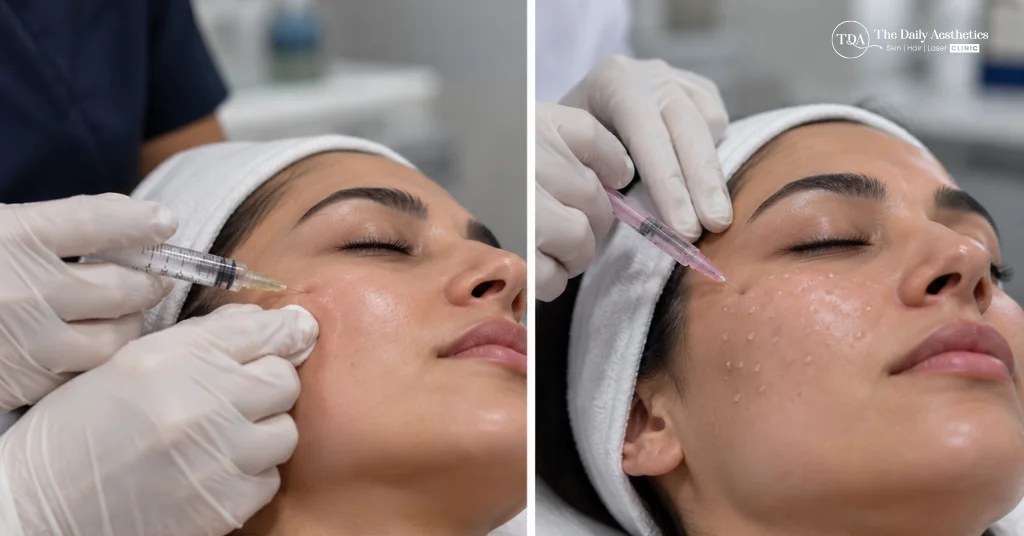
Introduction  You may have seen PDRN, PN, polynucleotides and Salmon DNA skin boosters everywhere lately. They sound similar, they are often used in the same conversations, and they are promoted for many of the same skin goals: glow, repair, hydration, texture, fine lines and early visible ageing.  The confusion is understandable. PDRN and polynucleotides are both DNA-derived regenerative treatments, but they should not be treated like two identical labels for the same thing. The formulation, molecular structure, treatment area, delivery method and your skin concern all matter.  At The Daily Aesthetics Clinic, many Pune patients ask a very practical question: should I choose PDRN, polynucleotides, Rejuran, Salmon DNA therapy or a different skin booster altogether? The honest answer is that the right choice depends on your skin, not the trend.  This guide keeps the comparison simple. You will understand how PDRN and polynucleotides overlap, where they may differ, what results may be realistic, and why consultation-led treatment planning is safer than choosing whichever acronym is popular online. Key Takeaways  Confused Between PDRN and Polynucleotides? A skin assessment can help match the treatment approach to your skin concern, treatment area and goals Book a Skin Consultation Are PDRN and Polynucleotides the Same Thing?  PDRN and polynucleotides are closely related DNA-derived treatments, but they are not always the same in practice. PDRN usually refers to polydeoxyribonucleotide fragments, while PN usually refers to longer polynucleotide chains. Both may support skin repair and quality, but product formulation and protocol decide the actual treatment experience.  Think of them as part of the same regenerative skin-treatment family. They are often discussed together because both are used to improve skin quality rather than reshape the face. Both may be delivered through microinjections or microneedling-style protocols depending on the product and clinical plan.  The mistake is assuming the labels alone tell the full story. A clinic may call a treatment PDRN, PN, Salmon DNA or a skin booster, but the actual product, concentration, purification process, delivery technique and treatment area are what shape the result.  That is why the better question is not only, “Which is better?” It is, “Which formulation and protocol fits my skin concern safely?” What Is PDRN?  PDRN stands for polydeoxyribonucleotide. In aesthetic skin care, it is used as a regenerative skin booster that may support skin repair, hydration, texture and overall skin quality. It is often discussed for dullness, fine lines, acne-marked texture, under-eye skin quality and post-procedure recovery planning.  For patients comparing options, PDRN Treatment in Pune can be discussed through consultation-led protocols that may involve microinjections or microneedling, depending on the treatment area, product and skin concern.  From a practical patient point of view, PDRN is usually chosen when the goal is not volume, but skin-quality support. It may be considered when the skin looks tired, damaged, dull, rough, dehydrated or less resilient than before.  Current clinical literature describes PDRN as a DNA-derived biopolymer that can act through tissue-repair pathways, including adenosine receptor-related mechanisms. That does not mean every patient gets the same result, and it does not make the treatment a cure for every texture, ageing or pigmentation concern.  What Are Polynucleotides?  Polynucleotides, often shortened to PN, are longer DNA-derived chains used in regenerative aesthetic treatments to support skin hydration, elasticity, texture and overall skin quality. They are often positioned as injectable skin boosters for patients who want progressive improvement without changing facial volume.  At The Daily Aesthetics Clinic, Polynucleotide Treatment in Pune is considered for patients who want gradual support for hydration, elasticity, texture and natural-looking skin-quality improvement.  Polynucleotide treatments may be discussed for fine lines, dull or tired-looking skin, enlarged-looking pores, uneven texture, early ageing changes, under-eye skin quality and selected acne-scar texture concerns. Like PDRN, results are usually gradual.  The evidence base for polynucleotides in aesthetic medicine is promising but still developing, which is why medically careful language matters. These treatments may support visible skin-quality improvement, but they should not be described as guaranteed collagen replacement or permanent anti-ageing solutions.  PDRN vs Polynucleotides: What Is the Main Difference?  The main difference is that PDRN usually refers to shorter polydeoxyribonucleotide fragments, while PN usually refers to longer polynucleotide chains. In everyday clinic conversations, both are used for regenerative skin-quality goals, but exact results depend on the product, molecular profile, delivery method and patient suitability.  This is where online comparisons can become too simple. Some content presents PN as “stronger” and PDRN as “lighter,” but that is not always clinically useful. Product quality, concentration, depth, number of sessions and treatment area may matter more than the acronym.  Use the table below as a decision guide, not a final diagnosis.  Comparison Point  PDRN  Polynucleotides / PN  What It Means for Patients  Full Form  Polydeoxyribonucleotide  Polynucleotides  Both sit within the DNA-derived regenerative skin-treatment category.  Molecular Profile  Usually shorter DNA fragments  Usually longer DNA chains  The exact formulation and product quality matter more than the simple label.  Common Treatment Emphasis  Repair support, glow, texture, under-eye quality and selected post-procedure recovery planning  Hydration, elasticity, skin density, fine lines and progressive rejuvenation  The overlap is significant, so suitability depends on assessment.  Result Style  Gradual skin-quality improvement rather than facial reshaping  Gradual skin-quality improvement rather than facial reshaping  Neither should be expected to work like a filler or surgery.  Best-Fit Discussion  May be discussed for tired, dull, damaged, thin or acne-marked skin  May be discussed for texture, elasticity, fine lines, hydration and overall rejuvenation  The same patient may be offered either depending on product availability and treatment plan.  Important Caution  Not every PDRN product or protocol is the same  Not every PN product or protocol is the same  Ask what formulation is being used and why it suits your concern.  Note: Categories can overlap. Individual products, concentrations, indications and delivery methods vary, so this table should not replace a clinical assessment.  Bottom Line: PDRN and PN are best compared by formulation, concern and treatment plan, not by declaring one universally better.  Compare the Options With a Professional Understand whether PDRN, PN or another skin-quality

PDRN vs Polynucleotides: What Is the Difference and Which Skin Booster Is Right for You? Read More »

PDRN Treatment
Skin Booster Treatment in Pune: Benefits & Cost

Skin Booster Treatment in Pune: Benefits, Types, Procedure, Cost & Results

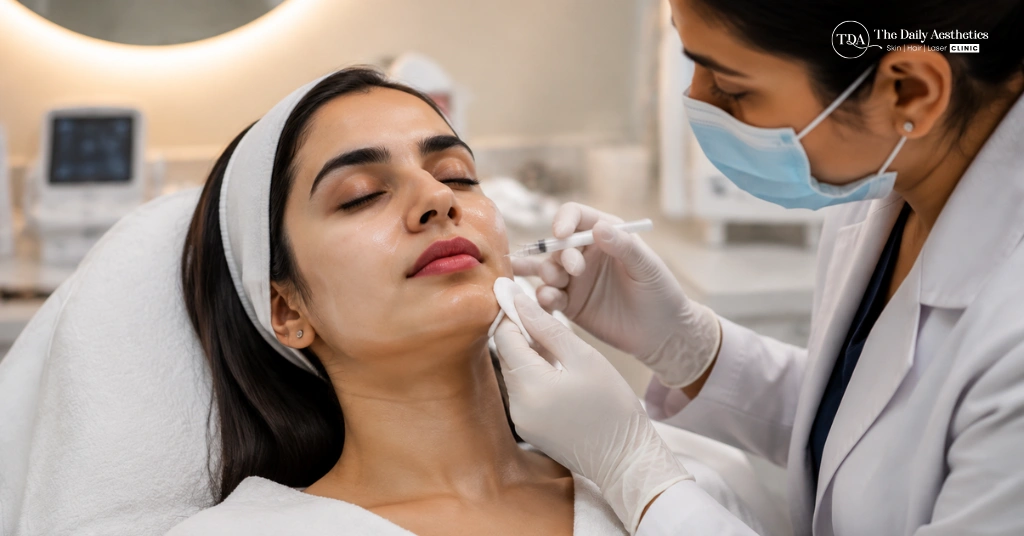
Introduction  Dry, tired, textured skin can feel confusing because it often does not look like one clear problem. Some people describe it as dullness. Some see fine lines. Some notice open pores, roughness, makeup sitting unevenly, or a glow that disappears no matter how much skincare they use.  Skin booster treatment is designed for this exact middle ground. It is not the same as a facial, and it is not meant to change your face like a filler. It works deeper than topical skincare to improve skin hydration, texture, radiance, and overall skin quality in a gradual, natural-looking way.  In Pune, where sun exposure, pollution, AC-heavy offices, stress, late nights, and active lifestyles can all affect the skin barrier, many patients look for treatments that refresh the skin without surgery or a dramatic change in facial structure.  This guide explains skin booster treatment in Pune in a practical, patient-friendly way. You will understand what it does, who it suits, what types are available, what happens during the procedure, what affects cost, what results look like, and when a consultation at The Daily Aesthetics Clinic may help you choose safely.  Key Takeaways  What is Skin Booster Treatment?  Skin booster treatment is a minimally invasive aesthetic treatment that places hydrating or regenerative ingredients into the skin to improve skin quality from within. A review in Cosmoderma describes skin boosters as dermal injections that can support hydration, collagen, elastin, texture, fine lines, and glow without working like traditional volumizing fillers.  Think of it as an internal skin-quality treatment. A serum sits on the surface. A facial can clean, exfoliate, and hydrate the outer layers. A skin booster is placed more directly into the skin, where it can support hydration and repair signals depending on the product used.  This is why many people describe skin boosters as a treatment for skin that looks tired even when they sleep well, drink water, and follow a basic skincare routine. The aim is not to make the face look different. The aim is to help the skin look fresher, smoother, and more resilient.  Common treatment areas may include the face, under-eye area, neck, hands, acne-marked areas, and sometimes the scalp when regenerative products are used for hair support. Suitability depends on your skin type, concern, medical history, and treatment goals.  Not Sure If Your Skin Needs Hydration or Repair? Speak with the team at The Daily Aesthetics Clinic to understand whether a skin booster, facial, peel, laser, or regenerative treatment suits your skin. Book a Skin Booster Consultation How is a Skin Booster Different From a Dermal Filler?  A skin booster mainly improves skin quality, while a dermal filler usually restores or adds volume. The American Society for Dermatologic Surgery explains that many fillers use hyaluronic acid and can temporarily plump, lift, or smooth specific areas. Skin boosters are used more superficially or diffusely for hydration, radiance, and texture.  This difference matters because many patients do not want their face to look “done.” They only want fresher skin, better bounce, smoother texture, or makeup that sits better. For those goals, a skin booster may feel more natural than a contouring treatment.  However, skin boosters cannot replace fillers when volume loss is the main concern. If cheeks look hollow, the under-eye area has structural shadowing, or the jawline needs support; your practitioner may discuss dermal fillers, HIFU, thread lift, or a combination plan instead.  Treatment  Main goal  Best suited for  What it usually cannot do  Skin booster  Improve hydration, glow, texture, elasticity, and skin quality  Dull, dehydrated, tired-looking, crepey, or mildly textured skin  Add major facial volume or lift heavy sagging  Dermal filler  Restore or enhance volume and contour  Hollows, contour loss, lips, cheeks, jawline, or deep folds  Improve overall skin quality as its main purpose  HydraFacial  Cleanse, exfoliate, extract, and hydrate the surface  Congested, dull, oily, or event-prep skin  Deliver injectable-level dermal hydration  Laser or peel  Target pigment, scars, pores, and damaged surface layers  Pigmentation, acne marks, tan, texture, or scars  Hydrate the dermis like a booster  PRP / regenerative plan  Support repair using growth factors or regenerative ingredients  Selected cases of dull skin, acne marks, or hair/scalp concerns  Act like instant filler or surgery  Note: Treatment choice should be based on skin assessment, not on trend names or package offers.  Bottom Line: Skin boosters are best understood as skin-quality treatments, not face-shaping treatments.  What Are the Main Benefits of Skin Booster Treatment?  Skin booster treatment can help people who want healthier-looking skin without a dramatic cosmetic change. The most common benefits include improved hydration, smoother texture, better glow, softer fine lines, improved elasticity, and support for tired or dull skin.  The emotional reason people choose this treatment is often simple: they want their skin to look like it has recovered. Not frozen, not filled, not filtered – just fresher and more comfortable in real life.  Patients commonly explore skin boosters for:  What Types of Skin Boosters Are Available in Pune?  The most discussed skin boosters include hyaluronic acid boosters, PDRN, polynucleotide treatments, Salmon DNA therapy, PRP, GFC, and combination skin-repair plans. Not every type is right for every person, and not every clinic uses the same products or protocols.  At The Daily Aesthetics Clinic, treatment planning may include regenerative options such as PDRN treatment, polynucleotide treatment, and Salmon DNA treatment when these are suitable after skin assessment.  Here is the practical way to understand the main categories:  Skin booster type  How it is commonly positioned  Best-fit concerns  Important note  Hyaluronic acid boosters  Microinjection-based hydration support for smoother, softer-looking skin  Dryness, fine lines, dullness, loss of bounce  Product choice and availability vary by clinic and indication  PDRN / Salmon DNA  Regenerative support using DNA-derived fragments to encourage repair signals  Dullness, fine lines, post-acne marks, under-eye tiredness, skin repair  Requires allergy and suitability screening, especially for fish-derived products  Polynucleotide boosters  Regenerative skin-quality treatment that supports collagen, elastin, and hydration pathways  Texture, elasticity, radiance, early aging, acne-marked skin  Usually works gradually over a series of sessions  PRP / GFC support  Uses patient-derived growth factors to support healing and repair  Selected skin rejuvenation or hair/scalp support cases  Results depend on patient factors and protocol quality  Combination

Skin Booster Treatment in Pune: Benefits, Types, Procedure, Cost & Results Read More »

Skin Care
Call WhatsApp
Scroll to Top